

Provably fair Bitcoin games let a player reproduce the calculation behind a completed result. The game first publishes a cryptographic commitment to a hidden server seed. The player then supplies or accepts a client seed. Afterwards, a nonce counts each bet under that seed pair. The game combines those inputs through a public algorithm. It later reveals the hidden seed. The player can then rebuild the result and compare it with the recorded round.
A valid match proves that the disclosed inputs produced that outcome under the published rules. It does not prove that the payout table is generous, the casino is solvent or licensed, and it does not replace Random Number Generator (RNG) testing. Bitcoin casino games often use the asset for deposits and withdrawals. The fairness proof can run off chain. This distinction matters for operators and players.
Key Takeaways
- The server must publish its seed commitment before the player locks the client seed.
- A verifier must recreate the final game result. A matching seed hash alone is incomplete.
- The round receipt must identify the algorithm version, input encoding, and payout rules.
- Bitcoin can fund the player wallet without taking part in result generation.
- Provably fair verification and independent RNG testing answer different questions.
- A valid proof does not remove the house edge or confirm operator solvency.
What Does Provably Fair Actually Prove?
Provably fair casino games need three linked evidence layers. The label does not describe one game type. The process creates a commitment before play. It then reveals enough data after play for another party to repeat the calculation.
A complete check proves three linked facts. The revealed server seed matches the earlier commitment. The recorded inputs create the same cryptographic output. And finally, the published game mapper converts that output into the displayed result.
Provably fair games do not earn the label from hash use alone. The proof stays valid only when the platform locks the commitment and client input and game rules in the correct order. A casino cannot publish a hash after it learns every result-driving input and still call that hash useful precommitment evidence.
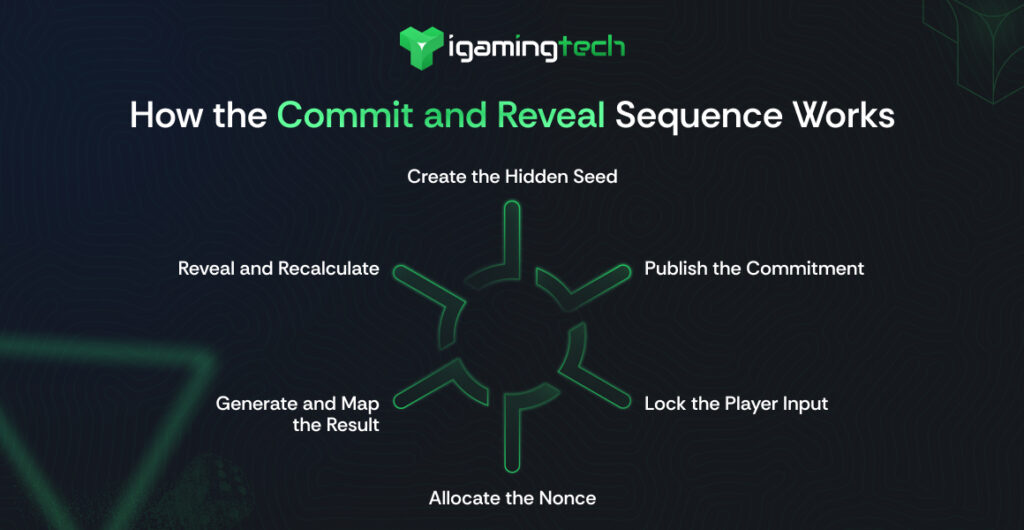
How the Commit and Reveal Sequence Works
The event order carries more security weight than the brand of hash function. A strong protocol completes these actions in order.
flowchart TB
A[“Publish server seed hash”] –> B[“Lock client seed and nonce”]
B –> C[“Generate cryptographic output”]
C –> D[“Map output to game result”]
D –> E[“Store versioned round receipt”]
E –> F[“Reveal seed and verify”]
1. Create the Hidden Seed
The server creates a high entropy secret with a cryptographically secure random source. Time alone cannot provide suitable entropy. Gaming Laboratories International (GLI) warns against time-only seeding in its GLI-19 Interactive Gaming Systems standard. The standard also requires cryptographic strength against prediction and state compromise.
2. Publish the Commitment
The server calculates a Secure Hash Algorithm 256 (SHA-256) digest of the hidden seed. It sends this digest to the player before the relevant client seed becomes final. The National Institute of Standards and Technology explains that secure hash digests can reveal whether input data has changed in Federal Information Processing Standard 180-4.
The digest acts like a sealed fingerprint. It hides a strong seed during play. It exposes any later seed change when the seed becomes public.
3. Lock the Player Input
The player enters a client seed or accepts one from the browser. A serious design lets the player replace the default. The platform records the exact text and character encoding. It also records the seed cycle and game identifier.
The commitment must already exist at this point. Otherwise, the operator can search through candidate server seeds after it knows the client value. This process is called seed grinding.
4. Allocate the Nonce
A nonce is an integer counter for bets under one seed pair. The service allocates it atomically. Atomic allocation means that concurrent requests cannot receive the same value. The database also enforces a unique constraint across the seed cycle and nonce.
5. Generate and Map the Result
Many designs use Hash-based Message Authentication Code with SHA-256 (HMAC-SHA256). HMAC combines a secret key with a message. Federal Information Processing Standard 198-1 defines the construction. The server seed can act as the key, and the message can include the client seed, nonce, and locked game identifiers.
The resulting bytes do not yet represent a dice roll or mine layout or crash point. A separate mapper converts those bytes into the game domain. That mapper forms part of the fairness contract.
6. Reveal and Recalculate
The platform reveals the server seed when it closes or rotates the seed cycle. The verifier hashes that seed first. It then repeats the HMAC and game mapping.
Build Casino Games Where Every Result Can Be Verified —Start Your Build
Contact Us
The Hidden Risk Sits in Result Mapping
The mapping stage is where many provably fair games lose technical credibility. An HMAC match only proves the raw bytes. The player still needs proof that those bytes became the result through the stated game rules.
The mapper changes with each game mechanic. This makes provably fair casino games a family of implementations rather than one reusable formula.
Consider this simplified flow.
commitment = SHA256 of server_seed
message = versioned client_seed plus nonce plus round_id
digest = HMAC-SHA256 using server_seed and message
result = documented mapper using digest and game_rules_version
The message format must state field order and separators and text encoding. It must also state whether the mapper reads bytes or hexadecimal text. Two systems can use the same visible values and still produce different results when these details differ.
A direct remainder operation can create modulo bias when the source range does not divide evenly into the target range. Rejection sampling can avoid this problem. It rejects source values outside the largest evenly divisible range. The mapper then draws more bytes. GLI-19 requires unbiased scaling and mapping. It also requires source review and distribution testing.
| Game | What the verifier must rebuild | Typical mapper failure |
| Dice | Exact bounded roll | Modulo bias or conflicting decimal rounding |
| Crash | Multiplier and cap | Hidden house edge constant or different overflow rule |
| Mines | Full mine layout without replacement | Duplicate tile selection or order drift |
| Plinko | Every left or right path decision | Too few digest bits or reused bit positions |
| Card game | Complete deterministic shuffle | Biased shuffle or platform-specific array order |
| Limbo | Result multiplier | Client and server use different precision rules |
A public verifier can faithfully reproduce a flawed mapper. That result is reproducible but still biased. Independent code review and statistical tests remain necessary.
Architecture for Verifiable Rounds
The fairness service belongs beside the game engine. It does not belong inside the Bitcoin wallet service. This boundary limits access to hidden seeds. It also makes the evidence path easier to test.
flowchart TB
A[“Player interface”] –> B[“Game request interface”]
B –> C[“Fairness service”]
C –> D[“Versioned outcome mapper”]
D –> E[“Append only round ledger”]
E –> F[“Reveal interface”]
F –> G[“Independent verifier”]
A –> G
An Application Programming Interface (API) lets software services exchange defined requests and responses. The game API locks the stake and paytable version before it asks for a result. The fairness service owns seed cycles and nonce allocation. The mapper owns game-specific conversion. The round ledger preserves evidence. The reveal API publishes closed seeds. The verifier runs the same published specification outside the result service.
| Component | Required responsibility | Failure to prevent |
| Player interface | Display precommitment, client seed, and receipt | Hidden proof data |
| Game API | Lock bet terms before result generation | Payout changes after the result |
| Fairness service | Protect seeds and allocate nonces | Seed leakage and nonce reuse |
| Outcome mapper | Apply one identified rule set | Undisclosed result conversion |
| Round ledger | Preserve immutable evidence fields | Rewritten game history |
| Reveal API | Publish closed seed cycles on schedule | Missing or delayed verification |
| Independent verifier | Recreate hash and result | Hash-only verification |
Crypto casino games often connect wallet events with game sessions and settlement records. The Bitcoin wallet tracks deposits and withdrawals and balance credits. The internal ledger tracks wager debits and wins. Neither record replaces the game receipt.
The Twinqo crypto casino case study documents connected wallet and gameplay operations. It does not publish a fairness algorithm or independent audit result. It supports the platform integration context only.
The Minimum Round Receipt
An operator needs more than three copied fields. Each settled round needs one exportable evidence package.
| Receipt field | Why it matters |
| Round Identifier (ID) | Connects the proof with game history and dispute records |
| Seed cycle ID | Prevents confusion after rotation |
| Server seed commitment | Proves the earlier locked fingerprint |
| Client seed | Preserves the player contribution exactly |
| Nonce | Identifies the calculation within the seed cycle |
| Algorithm version | Prevents silent logic replacement |
| Input format version | Fixes field order, separators, and encoding |
| Game mapper version | Identifies the result conversion |
| Paytable version | Connects the outcome with the payout rule |
| Bet terms | Locks stake and selected risk level and target |
| Raw digest | Helps diagnose calculation differences |
| Final result | Supports direct comparison with the displayed outcome |
| Settlement record | Connects the result with the wallet ledger entry |
| Reveal status | Shows when full verification became available |
The platform can hash each receipt. It can also combine daily receipt hashes into a Merkle root. A Merkle root is one digest that represents a set of records. Publishing that root outside the production database can make later history changes detectable. This optional control strengthens record integrity. It does not repair a flawed game mapper.
Design Verification for Real Players
A fairness page cannot work as a badge. The game history needs a visible Verify Round action. That action needs to open the exact receipt for the selected round. The player needs one tap to copy the data or download it.
The interface can explain the check in two levels. The first level answers whether the proof passed. The second level shows the inputs and calculation. This design keeps the first view readable on a small screen. It still gives technical users full evidence.
An external reference verifier adds more value than a second endpoint on the same private backend. The operator can publish its source and fixed test vectors. A test vector is a known input with its expected output. Browser and backend builds must pass the same vectors before release.
The verifier needs specific failure messages. Wrong nonce, wrong seed cycle, and unsupported version require different responses. A generic mismatch error makes genuine disputes hard to investigate.
Threat Model for the Fairness Layer
A fairness system can fail even when it uses strong cryptography. The review should therefore look at the entire process, not just the hash function. For each step, ask what could go wrong, how an operator or attacker could exploit it, what control prevents it, and how the platform would detect the problem.
| Threat | What can go wrong | Control | Monitoring and response |
| Seed grinding | Server chooses its seed after seeing the player’s input | Commit to the server seed first | Alert on any bet without an earlier commitment |
| Nonce collision | Two rounds receive the same nonce | Assign nonces atomically and enforce uniqueness in the database | Stop settlement and investigate the affected seed cycle |
| Mapper bias | The conversion from random data to a game result favors some outcomes | Use unbiased mapping such as rejection sampling and review the mapper | Run distribution tests for every mapper version |
| Verifier drift | Public verifier produces a different result from the game server | Use shared test cases and lock verifier versions | Stop release if server and verifier outputs differ |
| Seed exposure | An active server seed becomes visible to unauthorized people or systems | Encrypt seeds and restrict access | Rotate the seed and investigate affected rounds |
| Selective abort | Operator cancels a round after seeing an unfavorable result | Use fixed cancellation rules and an automatic reveal deadline | Flag every unresolved closed seed cycle |
| Mutable paytable | Payout rules change after the bet is placed | Store the paytable version with the round | Compare settlement against the locked terms |
| Encoding ambiguity | Different systems interpret the same inputs differently | Define one canonical byte format | Test the format across implementations |
Commit and reveal protocols can face withholding risk when a participant can choose not to reveal. Research on the last revealer problem examines this issue in distributed randomness systems. A casino design needs a deterministic response for any seed that misses its reveal deadline.
Provably Fair vs Certified RNG vs On Chain Verifiable Random Function
Operators need evaluation criteria before they choose a trust model. The useful criteria are proof scope, latency, operating cost, audit route, and failure ownership.
A Verifiable Random Function (VRF) creates a random value with a cryptographic proof. Some systems verify that proof on a blockchain.
| Criterion | Commit and reveal | Certified RNG | On chain VRF |
| Main assurance | Replays one disclosed outcome | Tests the RNG and game implementation | Verifies the source proof on chain |
| Player check | Direct after seed reveal | Usually indirect through certification | Direct through chain data and contract logic |
| Result latency | Low for off-chain calculation | Low | Depends on chain confirmation and callback |
| Per-round network cost | Low | Low | Chain fee or oracle fee may apply |
| Main trust dependency | Correct commitment order and mapper | Testing lab and controlled production build | Oracle design and contract code and chain state |
| Main failure risk | Seed timing or reveal failure | Undisclosed production change | Fallback error or finality delay or contract flaw |
| Best fit | Casino originals with simple reproducible math | Licensed games that require lab evaluation | Smart contract products that need public proof |
These models can work together. An operator can use commit and reveal for player receipts. It can also submit the RNG, mapper, and game math for independent testing. A smart contract product can use a VRF when public on-chain verification justifies the added latency and cost.
Turn Your Casino Concept Into a Provably Fair Platform —Discuss Your Idea
Contact Us
Why Independent Testing Still Matters
The United Kingdom Gambling Commission requires game results to remain acceptably random under Remote Gambling and Software Technical Standard 7. Its guidance covers expected distributions, unpredictability, safe seeding, and unbiased scaling. It also bars adaptive behaviour that changes results around player activity.
GLI-19 goes further into test evidence. It calls for source review of randomness, scaling, and shuffle code. It also calls for statistical analysis of distribution and independence. The tests work together at a stated confidence level.
These requirements show the assurance gap. A player-side proof can show that one round followed the disclosed algorithm. It cannot by itself establish that the disclosed algorithm meets a regulator’s full technical standard. Each target jurisdiction decides which testing, certification, and operational controls apply. Operators need qualified legal and compliance review before launch.
Bitcoin funding creates another compliance track. Know Your Customer (KYC) controls verify player identity. Anti-Money Laundering (AML) controls identify and manage financial crime risk. The exact duties depend on the licence, market, and transaction model. A fairness proof does not satisfy those duties.
When Provably Fair Logic Adds Little Value
Third-party crypto casino games do not become verifiable when an operator wraps the received result in a new hash. That wrapper only proves that the platform hashed data it received. It does not prove how the studio generated the spin.
Do not use commit and reveal for a live dealer result that comes from a physical wheel or card shoe. The assurance belongs in studio controls and equipment testing and event records.
Do not force every low latency round through a public blockchain when off-chain receipts meet the product need. Confirmation delays and fees can damage the game loop without improving the mapper.
Do not launch the feature when the team cannot preserve algorithm versions or reveal old seeds or publish exact input rules. A vague verifier can create more disputes than trust.
Operator Acceptance Test Before Launch
An operator can approve provably fair casino games only when the engineering team can produce evidence for every item below.
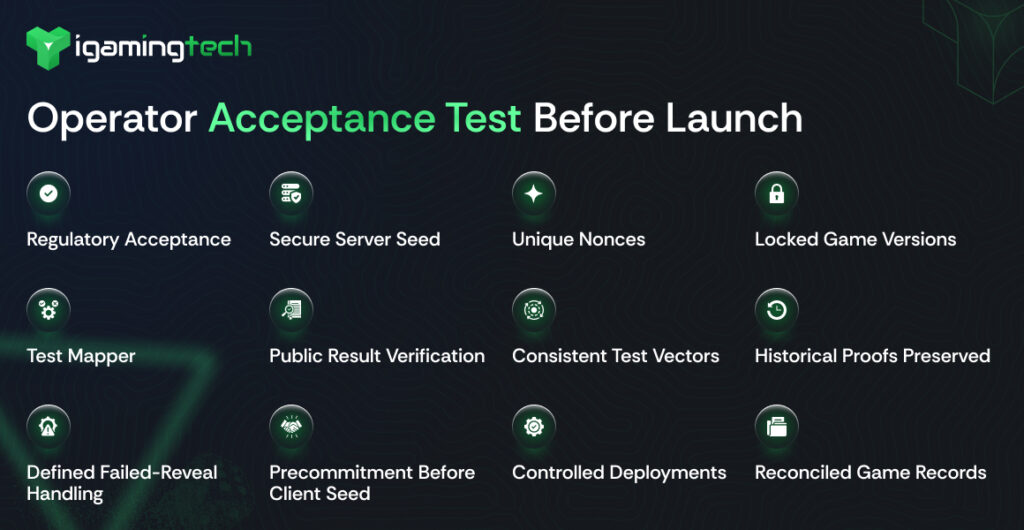
- The wallet ledger reconciles with settled game receipts.
- The server seed comes from a cryptographically secure source.
- The nonce remains unique under concurrent and retried requests.
- The round receipt locks the algorithm, mapper, and paytable versions.
- The mapper passes code review and game-specific distribution tests.
- The public verifier reproduces both the digest and final result.
- Independent implementations pass the same test vectors.
- Seed rotation never removes access to past proofs.
- Failed reveals trigger a defined void or settlement response.
- The precommitment reaches the player before the client seed becomes final.
- Deployment controls prevent unapproved fairness code from reaching production.
- The target regulator or test laboratory accepts the planned evidence route.
Engineering Scope for iGamingTech
A provably fair game project needs a written fairness contract before interface work begins. That contract defines input order and seed ownership, byte encoding, nonce rules, game mapping, and reveal timing. It also defines the round receipt and dispute path.
iGamingTech can connect this scope with the surrounding casino product through its provably fair casino game development service. A relevant build can use ReactJS or NextJS for the verifier interface. Node.js or NestJS can run a separate fairness service. PostgreSQL can enforce nonce uniqueness and preserve round records. GitHub Actions can execute fixed test vectors before deployment. Docker and Kubernetes can isolate and deploy versioned services.
These technology choices do not create fairness on their own. The security comes from the protocol order, a protected seed lifecycle and unbiased mapper, and reproducible evidence.
Conclusion
Provably fair Bitcoin games create useful evidence when the platform commits first and maps results without bias and preserves every version needed for replay. The strongest implementation proves more than a matching seed hash. It proves the exact path from locked bet terms to cryptographic output to displayed result to settlement.
Bitcoin does not make that path fair by itself. The wallet and game systems solve different problems. Independent RNG testing, game math review, and jurisdictional approval also remain separate.
If you are evaluating a custom game, then start with the fairness contract and round receipt. These two artifacts expose hidden assumptions before provably fair game development begins. They also give product, engineering, and compliance teams one shared approval standard.
Ready To Build Your Own Sportsbook Platform?
Launch a secure, scalable, and fully integrated sportsbook designed to grow your business faster.


