

A casino operator adds games from a new provider. Players can open them in the lobby. Yet some game tiles lack links search engines can follow. Category pages offer little information about the new games. The operator decides which pages belong in search and what each page needs to explain.
A casino SEO strategy connects those decisions to the casino’s licensed markets. The team can then test crawl access and page content before release. The team measures qualified search visits and inspects AI search results. This guide follows the provider launch through those decisions.
What Does a Casino Operator Decide Before Starting SEO?
A new game provider may offer more titles than a casino can launch in every market. The product owner confirms which games players can actually open. The compliance reviewer checks the descriptions and terms before the team publishes them.
1. Define the Market and Goal
The casino might offer the full game catalog in one market and only selected titles in another. Public terms may differ as well. An online casino SEO plan follows those differences.
The marketing lead also chooses a goal for the launch. The team may want more visits to an approved game category. It may want more registrations from a target market. A higher visitor count means little if those visitors cannot access the games.
2. Record the Starting Point
The team reviews existing category pages before the new provider goes live. Google Search Console shows their clicks and impressions by country. The analytics owner checks how the casino attributes registrations to organic search. If that tracking is missing, then the team fixes it before comparing results.
How Does a Casino SEO Strategy Match Searches to Pages?
The provider launch creates different search questions. One player looks for the provider’s games. Another looks for the rules of a single title. A third wants withdrawal information. The SEO team gives each question a clear page destination.
1. Find Provider Games
A search for the provider’s available slots maps to a provider collection. That page lists the games offered in the player’s market and links to individual titles. It excludes games that have not launched there.
2. Understand One Game
A search about one slot’s rules maps to its game page. The page explains that title and shows where players can access it. Several searches about the same game can lead to one page. Google can understand related wording without a separate page for every phrase.
3. Answer Payment Questions
The operator assigns withdrawal questions to a payment or support page. Players can find the current process there. A provider collection has no useful answer to that question.
4. Check Existing Pages
The SEO lead compares queries with pages that already receive Google Search traffic. Search Console provides query and page data for that review. If the lobby attracts provider searches, then the team checks why the provider collection does not answer them. The page map records the intended destination and any missing information before the team requests a new page.
Which Casino Pages Belong in Search Results?
A provider launch can create a collection page and many game URLs. Lobby filters and promotions can add more. The operator decides which pages offer a useful search destination before the release.
1. Game Page Selection
A working game URL does not always give players more information than the provider collection. The team compares the two pages before adding the game page to its search plan.
- The provider collection lists the games available in each market.
- An individual game page earns a place when it answers a question about that title.
- The team verifies its rules and availability before publication.
- A bare game tile can stay in the lobby without a search page of its own.
2. Filter URL Control
A player may change the lobby sort order without changing the games on display. Some platforms give every filtered view a separate URL. The team checks which of those addresses have a distinct purpose.
- The SEO lead identifies filters that create separate URLs.
- A sort order with the same games rarely needs its own search page.
- The team marks one listing as the preferred canonical URL and links to it consistently within the site.
- Google can choose a different URL despite that canonical signal.
3. Promotion Page Lifecycle
A promotion page can remain in search after its offer ends. The operator tracks the offer status alongside the page so visitors do not find outdated terms.
- A continuing offer can keep one page that the team updates.
- The team confirms that the displayed terms apply in the relevant market.
- An expired promotion stops presenting old terms to search visitors.
- The operator redirects an old offer page only when the replacement serves the same purpose.
4. Search Exclusion Rules
Some pages remain useful inside the casino lobby without serving as search results. The page inventory records that decision for each page type.
- The operator identifies public pages that have no useful place in Google Search.
- A noindex directive tells Google to leave a page out of its results.
- Google can apply noindex only after it crawls the URL and reads the directive. A robots.txt block can prevent that.
- The team records the intended search status before the provider release.
Improve Casino SEO and Organic Visibility —Get Your SEO Audit
Contact UsHow to Test Casino Website Crawling and Rendering
Technical SEO for casino websites begins with the public version of each page. The new provider may look complete inside the lobby while a public visitor reaches a location notice or a page with no game details. The release team tests the live information pages that it wants search engines to find.
1. Public Page Access
A signed in player and a search crawler can receive different pages. The team checks the public provider page before judging its search readiness.
- Open the page without an account or saved cookies.
- Record its response status and any location redirect.
- Inspect the live page in Google Search Console.
- Keep the affected page address with each failed test.
2. Rendered Game Content
A page may load its game list through a script after the first response. The team compares the initial page with Google’s rendered view.
- Confirm the provider name appears as readable text.
- Check that the live market details appear on the page.
- Follow game links without using the lobby search.
- Flag links that open an unavailable game or blank page.
3. Market Access Rules
A public information page and a playable game serve different purposes. Age prompts and location checks can protect game access while approved information remains available on a public page. The operator tests those paths separately.
- Describe a game publicly only where the market permits that information.
- Keep required age and location checks on the game experience.
- Check what a visitor outside the permitted market receives.
- Give Googlebot the same regional treatment as visitors from its location.
How to Create Accurate and Useful Casino Content
The new provider may supply descriptions for every game in its feed. The editor checks those descriptions against the games the casino actually launched. A page can look detailed and still describe a feature that players cannot use. A claim record gives the team a way to catch that error before publication.
| Page detail | Verification source | Editorial decision |
| Game rules and features | Provider specification and launched game | Describe the features available in the live version. |
| Market availability | Live catalog for each market | Name only the markets where players can access the title. |
| Promotion terms | Current approved offer | Check the dates and conditions before publishing the claim. |
| Responsible gambling information | Approved market content | Send the wording to the compliance reviewer. |
If the feed names a feature that the live game does not show, then the editor removes that claim and asks the product owner to resolve the mismatch. The provider collection can then explain real differences among its games. It does not need the same description beneath every title.
Product owners confirm game facts. Compliance reviewers check licensing claims and responsible gambling language. The editor keeps the source and review date for details that may change after release. Google’s content guidance also emphasizes original and reliable information that serves readers.
How Can Casino Pages Appear in AI Search Results?
A casino can launch new games while leaving useful details inside the game lobby. AI search optimization for casinos starts with public pages that answer real player questions. The new provider launch offers a way to check this.
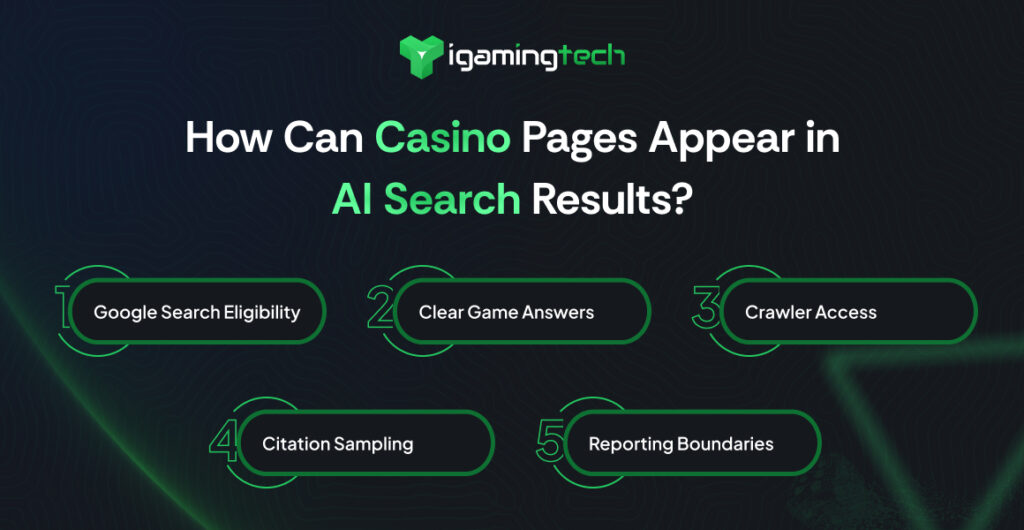
1. Google Search Eligibility
Google AI Overviews and AI Mode can show a page as a supporting link when Google has indexed it and can display a search snippet. After launch, the operator inspects each target page in Search Console. The team checks its index status and the canonical page Google selected. A special AI file or schema does not guarantee inclusion.
2. Clear Game Answers
A player might ask which titles the new provider offers in a licensed market. The provider page can name the live titles and state their availability. Each linked game page can explain features present in the live version. These details give an answer system a page to consider.
3. Crawler Access
Google Search eligibility does not establish access for every AI service. Other services may use different crawlers or retrieval processes. The operator checks hosting rules and public page responses for each service it evaluates. Allowing access does not guarantee a citation. Game access controls remain in place.
4. Citation Sampling
The marketing lead keeps a fixed set of relevant Google queries and AI prompts. The team repeats the tests over time and records the wording and cited page addresses. It also records the date and market. Results can change with wording and location. Account context and timing can change them too. This sample shows observed citations. It does not measure all AI traffic.
5. Reporting Boundaries
Google Search Console reports impressions in Google’s AI search features when enough data exists. It does not measure other answer services. The operator reports those impressions and manual citation observations apart from organic clicks. Separate acquisition reports track registrations and deposits under the team’s channel rules. A citation alone cannot assign credit for either outcome.
What Happens When a New Game Provider Goes Live?
When a casino adds a game provider, the casino SEO strategy becomes part of the release plan. A working game connection does not tell the content team which titles players can access in each licensed market. The team needs an approved game list before it publishes search pages.
1. Provider Connection
The platform team connects the provider feed and maps its game identifiers to the live catalog. It tests whether selected games open correctly. iGamingTech’s Slotocafe platform case study describes provider connections and game access within a casino platform.
2. Market Selection
The product owner identifies the titles available in each market. Compliance reviews market claims and any offers tied to the new games. The editor works from that approved list rather than publishing every title in the feed.
3. Page Publication
The editor matches the approved list to the provider page and selected game pages. The release ticket records each page address and its owner. The platform team checks the published pages for visible text and working game links.
4. Release Decision
A game can appear in the lobby while its search page waits for review. The content team publishes the page once its game details match the live catalog. This keeps an unfinished page from describing a title players cannot access.
5. Catalog Follow Up
Provider feeds can change after launch. A title may disappear or move to another category. The team compares public pages with the current catalog after each update. It fixes broken links and outdated availability claims.
What Do Casino SEO Services Include?
An operator can compare proposals by reviewing the work each team will deliver. A useful scope names the pages in focus. It also shows who owns each change and how the operator can check the result.
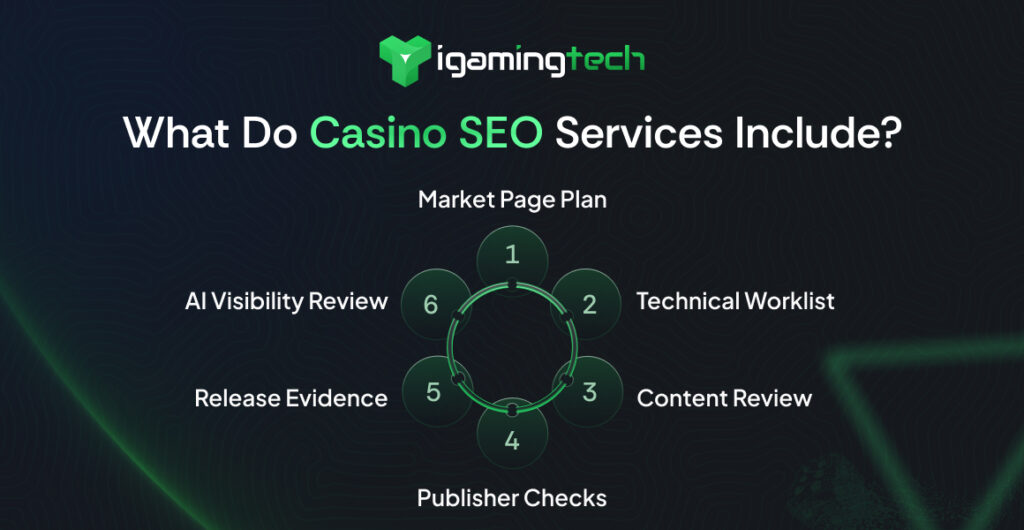
1. Market Page Plan
The plan sets page priorities for each licensed market before the team requests new content or development work.
- The agency lists the licensed markets in scope.
- Provider searches map to suitable collection pages.
- Selected game pages have a distinct search purpose.
- Filter pages and expired offers receive an exclusion decision.
2. Technical Worklist
A developer needs enough detail to reproduce an issue. Each task connects a live page to a specific fix.
- Each ticket names the affected page.
- A live test records the issue.
- The ticket names the required change.
- An acceptance check confirms the result.
3. Content Review
The review record shows where game claims came from and who approved the published wording.
- Provider specifications support feature claims.
- Live catalog checks confirm market availability.
- Approved terms support promotion copy.
- Product and compliance owners record their approval.
4. Publisher Checks
If the proposal includes external link work, the operator can review the planned placements before outreach.
- The publisher lists names of proposed sites.
- Each site has a relevant audience.
- The plan identifies its destination page.
- The report includes links to live placements.
5. Release Evidence
After deployment, the agency retests changed pages. The operator can see which fixes worked and which issues remain open.
- Public pages receive a fresh access check.
- Rendered text and game links receive a second review.
- Open issues retain a named owner.
- The report records each test date.
6. AI Visibility Review
This separate review records observed citations for a fixed set of player questions. It gives the operator a way to compare results over time.
- The team saves the approved question set.
- Each test records the service and market.
- The log captures cited pages and test dates.
- The report separates citations from organic clicks.
An operator looking to find casino SEO services to improve the results in generative engines can request examples of these deliverables. iGamingTech’s iGaming SEO services describe its technical and content work for gaming businesses.
Boost Casino Visibility in Search and AI —Explore SEO Services
Contact UsHow Casino SEO Scope Changes Cost and Timeline
The cost of a casino SEO strategy depends on the pages and licensed markets in scope. An operator can budget for a technical audit separately from ongoing work. The timelines below cover audit delivery and planned reviews.
|
Project Scope |
Work Included |
Indicative Cost Range in USD |
Work Timeline |
| Focused technical audit | Reviews crawl access and indexation across key page templates. Delivers a prioritized fix list. | $1,400 to $2,000+ | 3 to 8 business days depending on site size |
| Single market program | Covers technical priorities and content work for one licensed market. | $4,000 to $8,000+ | Monthly work with a first review at 90 days |
| Multi market program | Covers page planning and ongoing technical and content work across several markets. | $8,000 to $20,000+ | Phased market work with a first review at 90 days |
| Large market program | Coordinates SEO work across multiple brands or large market portfolios. | $20,000 to $60,000+ | Ongoing work with reviews every 90 days |
The audit ends with findings that the platform team can act on. Engineering releases and compliance approvals affect when fixes go live. A quote can list those costs and any publisher fees separately. Search rankings and AI citations need monitoring after publication.
How Do Operators Measure Search and AI Results?
A casino SEO strategy becomes easier to assess when reporting follows each page after release. The new provider launch sets a starting date. Marketing teams can then compare search visibility with player activity.
1. Release Record
A release record identifies the provider pages that went live. It gives later reports a consistent set of URLs to review.
- Editors log the date each page first becomes public.
- Product owners verify the licensed market for each URL.
- Platform engineers note the template used at launch.
- A release log separates later content edits from platform fixes.
2. Search Performance
Search Console shows how the released pages perform in Google Search. Market filters keep the review focused on places where players can access the games.
- Index checks show which target URLs Google has indexed.
- Page reports list clicks and impressions for each URL.
- Country filters isolate traffic from licensed markets.
- Low click rates prompt a review of titles and search queries.
3. AI Exposure
Google’s AI report and a fixed prompt sample provide two different views of visibility. The team records each one separately.
- Google’s report shows available AI impressions by page and country.
- Low impression volumes can leave that report unavailable.
- A prompt log captures cited URLs observed in other AI tools.
- Monthly summaries distinguish sampled citations from Google impressions.
4. Player Activity
Site analytics and player records show what happens after a search visit. Consistent channel rules and reporting windows make each month easier to compare.
- Analytics groups organic search sessions by landing page.
- Attribution rules connect eligible visits with verified registrations.
- Deposit reports count first deposits within the agreed reporting window.
- Separate channel reports track affiliate referrals.
Bottom Line
A new game provider can go live while its pages remain difficult to find in search. The operator can start by identifying licensed markets and deciding which provider and game pages offer enough value to index. Platform teams can then test what crawlers see before the next release repeats the same problems.
Product owners verify game details. Compliance reviewers check market claims. Search teams track the approved pages through indexing and search performance. Player records show what happens after a visit. AI visibility remains a separate measure.
A technical review of provider and game page templates gives iGamingTech and the operator a concrete starting point. It can identify crawl barriers and repeated pages before they shape the next SEO worklist.
Ready To Build Your Own Sportsbook Platform?
Launch a secure, scalable, and fully integrated sportsbook designed to grow your business faster.


