

Sports bettors often check odds before placing a wager. Yet odds alone do not show the full return. A sports betting calculator helps users understand stake profit payout and possible risk before they place a bet. It gives a clearer view of how much a wager can return and how the odds affect the final amount.
This matters for single bets, parlays, and different odds formats. A clear calculation helps users avoid guesswork and compare possible outcomes with confidence. It also helps them understand the difference between total payout and actual profit.
This guide explains how the tool works and what each result means. It also shows how bettors can use it for better planning across sports betting markets.
What Is A Betting Calculator?
A betting odds calculator helps users estimate the possible return before they place a wager. It uses the stake and selected odds to show expected profit and total payout. This makes the result easier to understand than odds alone.
A user may enter a $100 stake with +150 odds. The tool can show a $150 profit and a $250 total payout. This simple view helps users compare bet value before they confirm the bet.
For betting businesses, this feature adds more than convenience. It supports clearer bet slips and better user confidence. It can also reduce confusion around odds formats and payout values. A well-placed calculator can improve the betting journey because users get quick answers inside the platform instead of checking another tool.
How A Sports Betting Calculator Works
A calculator gives users a clearer view of possible returns before they place a wager. It reads the stake and odds, then shows profit and total payout. This makes bet planning easier for beginners and regular bettors.
1. Enter The Stake
A user starts by adding the stake amount. This is the money placed on the bet. The tool uses this value as the base for every return calculation. A clear stakeholder input helps users test different amounts before they decide how much risk they want to take.
2. Add The Odds
The next step is adding the odds shown by the sportsbook. The tool reads the odds format and applies the right formula. It can support American odds, decimal odds, or fractional odds. This helps users avoid manual errors when odds appear in different formats.
3. Review Profit & Payout
The result shows possible profit and total payout. Profit means the amount the user can win from the bet. Payout means the profit plus the original stake. For example, a $100 stake at +150 odds can return $150 in profit and $250 as total payout. This helps users see the real return before they place the bet.
4. Understand Market Chance
Some tools also show implied probability. This shows how likely the market expects an outcome to be. It helps users compare odds with more clarity. It also helps them understand why high odds can return more but usually carry more risk.
Essential Inputs For Accurate Bet Calculation
Users need a few details before they can calculate a return. A clear input flow helps the tool show a more accurate result. It also helps users compare possible outcomes before they choose a stake.
Stake Amount
The stake is the amount a user wants to place on a bet. A sports betting calculator uses this number as the base for payout and profit. A $50 stake will return less than a $100 stake at the same odds. This helps users test risk before they confirm the wager.
Odds Format
Odds can appear in American decimal or fractional format. The user must choose the format shown by the sportsbook. This helps the tool apply the right calculation. It also prevents wrong payout results when users compare odds across different betting sites.
Bet Type
The bet type tells the tool how to read the wager. A single bet has one selection. A parlay has more than one selection. This input matters because each bet type uses a different payout logic. It also helps users understand why risk changes with more selections.
Number Of Selections
Selections are the picks added to the bet slip. A single bet needs one selection. A parlay needs two or more selections. Each extra selection can raise the possible payout. It can also lower the chance of winning because every selection must settle correctly.
Expected Return
The expected return shows the amount a user may receive if the bet wins. It usually includes profit and the original stake. This helps users understand the difference between winnings and total payout. It also gives them a clearer view before placing money on the line.
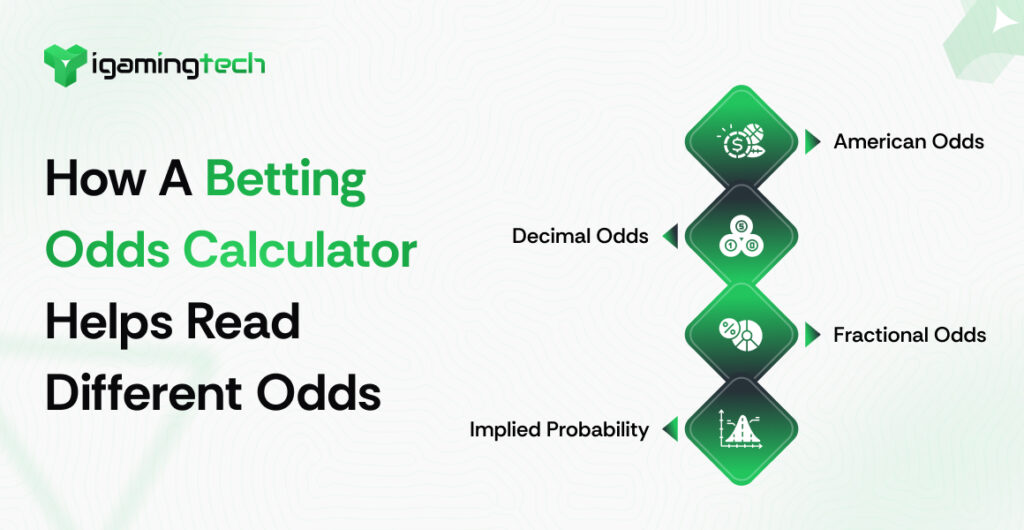
How A Betting Odds Calculator Helps Read Different Odds
Odds can look different across sportsbooks and regions. This can confuse users when they compare possible returns. A betting odds calculator helps users read each format and understand how the same bet value can appear in different ways.
1. American Odds
American odds often use plus or minus values. Plus odds show how much profit a $100 stake can win. Minus odds show how much a user must stake to win $100. For example, plus 150 means a $100 stake can make a $150 profit. This makes American odds useful for moneyline markets and quick payout checks.
- Shows profit based on a $100 stake
- Works well for moneyline markets
- Helps users compare favourites and underdogs
- Makes payout checks easier before bet placement
2. Decimal Odds
Decimal odds show the total return for every $1 staked. This total includes the original stake. For example, decimal odds of 2.50 mean a $100 stake can return $250 in total. The profit would be $150. This format is simple because users only multiply the stake by the odds.
- Shows total return in one number
- Includes the original stake in the result
- Makes payout calculation simple
- Helps users read odds faster across global markets
3. Fractional Odds
Fractional odds show the profit compared with the stake. For example, 3/2 means a user can win $3 for every $2 staked. A $100 stake at 3/2 can make a $150 profit. The total payout becomes $250. This format is common in traditional betting markets and still appears on many sportsbook pages.
- Shows profit against the stake amount
- Works well for traditional betting markets
- Helps users compare return ratios
- Supports a clearer understanding of older odds formats
4. Implied Probability
Implied probability shows the chance suggested by the odds. It turns the odds into a percentage. For example, decimal odds of 2.50 suggest a 40 percent implied chance. This helps users understand market expectations before they place a wager. It also helps them compare prices and risks with more clarity.
Implied Probability = 1/ Decimal odds
- Converts odds into a percentage
- Helps users understand market expectations
- Supports better odds comparison
- Shows why higher returns often carry more risk
| Odds Format | Odds Shown | Profit On $100 | Total Return | Best Used For |
| American | +150 | $150 | $250 | U.S. sportsbook odds |
| Decimal | 2.50 | $150 | $250 | Simple payout checks |
| Fractional | 3/2 | $150 | $250 | Traditional betting markets |
Add a Smart Betting Calculator to Your Platform —Talk to an Expert!
Contact UsHow a Sports Betting Payout Calculator Shows Profit & Return
A payout tool helps users see the full value of a wager before they place it. It shows more than possible winnings. It separates actual profit from the total amount returned. This helps users understand the bet result with less confusion.
1. Profit Shows The Real Winning Amount
Profit is the amount a user wins after removing the original stake. It shows the actual gain from a successful wager. This matters because a large payout can look better than the real profit. Clear profit visibility helps users judge the value of a bet with more accuracy.
2. Payout Includes Stake And Profit
Payout is the full amount returned after a winning bet. It includes the original stake and the profit. This distinction helps users avoid confusion when checking possible returns. A clear payout view also supports better stake planning before the bet is placed.
3. Higher Odds Can Increase Returns
Higher odds can create a larger possible return. They often point to a result that may be harder to win. This is why a bigger payout can also carry more risk. Users should look at the return value and the winning chance before placing the wager.
4. Lower Odds Reflect A Stronger Favourite
Lower odds usually return less profit. They may still appeal to users because the outcome can look more likely. A strong favourite can offer a smaller payout but a more balanced risk level. This helps users compare safer choices with higher return options.
How a Parlay Calculator Works for Multiple Selections
A parlay combines two or more selections into one wager. Each selection must win for the full bet to pay out. This is why the return can look higher than a single bet. It also means the risk grows with every extra selection.
1. Add Each Selection
A user starts by adding each pick to the bet. Each pick is known as a leg. The tool reads the odds for every leg and combines them into one final value. This helps users see how each selection changes the full bet return.
2. Combine The Odds
The tool usually converts each selection into decimal odds. It then multiplies those values together. A Parlay calculator makes this step easier because users do not need to calculate each leg manually. This also reduces mistakes in multi selection bets.
3. Check The Final Payout
The final payout depends on the stake and combined odds. For example, a user places $30 on two selections with decimal odds of 1.80 and 2.20. The combined odds become 3.96. The total payout becomes $118.80. The profit becomes $88.80.
| Stake | Leg 1 Odds | Leg 2 Odds | Combined Odds | Profit | Total Payout |
| $30 | 1.80 | 2.20 | 3.96 | $88.80 | $118.80 |
Combined odds = 1.80 × 2.20 = 3.96
Total payout = $30 × 3.96 = $118.80
Profit = $118.80 minus $30 = $88.80
Understand The Risk
A higher number of selections can increase the possible payout. It can also make the bet harder to win. If one selection loses, then the full bet usually loses. This is why users should check the return value and risk before placing a multi-selection bet.
What Do Betting Calculator Results Really Mean
A sports betting calculator gives more than one final number. It helps users read the full value of a wager. Each result shows a different part of the bet. This makes the outcome easier to understand before the user places money on the line.
1. Potential Winnings
Potential winnings show the profit a user can make if the bet wins. This amount does not include the original stake. It helps users see the actual gain behind the odds.
- Shows the possible profit
- Excludes the original stake
- Helps users compare bet value
- Supports smarter stake planning
2. Total Payout
Total payout shows the full amount returned after a winning bet. It includes the original stake and the profit. This result gives users a clearer view of the full return.
- Includes stake and profit
- Shows the complete return
- Reduces confusion around winnings
- Helps users plan bet value clearly
3. Implied Probability
Implied probability turns odds into a percentage. It shows the chance suggested by the market. This helps users understand why some odds offer higher returns than others.
- Converts odds into a chance value
- Shows market expectation
- Helps compare different odds
- Supports better risk reading
4. Risk Level
Risk level helps users understand how difficult a bet may be. Higher returns often come with higher risk. This result helps users avoid judging a bet only by payout size.
- Highlights possible betting risk
- Explains why high odds pay more
- Helps users avoid blind decisions
- Supports more balanced bet planning
5. Odds Value
Odds value helps users compare the return against the possible chance of winning. It shows if the payout looks fair for the risk involved. This can help users make more informed betting choices.
- Helps compare prices and returns
- Supports better odds analysis
- Gives more clarity before betting
- Helps users judge bet quality
Calculator Versus Prediction Tools
A calculator and a prediction tool support different user needs. One explains the return value. The other supports data based betting decisions.
| Comparison Point | Betting Calculator | Prediction Tool |
| Main Purpose | Calculates profit payout and possible return | Reviews match data and outcome potential |
| User Input | Stake odds and bet type | Team data player form past results and market trends |
| Output | Shows how much a bet can return | Shows insights that may support a betting decision |
| Data Use | Uses fixed betting formulas | Uses historical data, live data, and predictive models |
| Best For | Checking the bet value before placement | Studying possible outcomes before selection |
| Limitation | Does not predict match results | Does not guarantee winning outcomes |
| Business Value | Adds payout clarity inside the betting journey | Adds advanced decision support inside the platform |
A calculator helps users check the money value of a wager. On the other hand, a prediction tool helps users study the possible outcome before making a selection. Both features can work together inside a betting product. Sports betting prediction platform development supports businesses with predictive insight for advanced data based features.
Why Betting Calculators Matter For Sports Betting Apps
A betting app helps users act with clarity. A calculator adds that clarity before a wager is placed. It shows the stake return and possible profit in a simple way. This helps users understand the value of a bet without switching to another tool. A Sports Betting app development company helps businesses to add this feature inside the bet slip user dashboard or odds screen.
Fast calculations also improve the full betting journey. Users can test odds, check returns, and adjust stakes with less effort. This supports cleaner bet slips and fewer errors during selection. It also improves trust because users can see the expected return before they confirm a wager. Strong sports betting app performance makes this experience smoother across live markets and busy betting hours.
Secure Calculator Features For Betting Platforms
A betting calculator must show correct results every time. Users trust the tool only when the odds data stake value and payout output stay accurate. Secure data handling also matters because betting platforms process user activity and transaction related actions.
1. Secure Data Handling
Calculator features should protect user inputs and session activity. The system should not expose stake values, account details, or betting behaviour. Strong online gambling security helps platforms keep user trust while supporting safer betting experiences.
2. Accurate Odds Feeds
Odds must update with the sportsbook data source. Old odds can create wrong payout results and user confusion. A reliable calculator should read fresh odds and show the correct return before the user confirms a wager.
3. Result Validation
The platform should validate every calculation before it appears to the user. This helps detect wrong odds formats, missing stake values, and broken payout logic. Accurate validation also reduces disputes linked to unclear betting returns.
4. Responsible Betting Controls
Calculator tools should support safer bet planning. Users should see possible profit payout and risk before placing money on the line. This helps them make informed choices and avoid relying only on high return numbers.
Build Custom Betting Tools for Better User Decisions —Schedule a Call!
Contact UsHow Operators Can Use Betting Calculators
A betting calculator can become a useful product feature for sportsbook operators. It helps users check possible returns before they place a wager. It also supports clearer bet slips and smoother betting decisions. For businesses, this feature can reduce confusion around stake odds and payout.
Custom Calculator Modules
Operators may need calculator modules inside betting app platforms or admin systems. These modules can support single bets, parlay odds conversion, and payout checks. A custom setup can also match the platform rules and betting markets. This makes the calculator feel like part of the product instead of a separate tool.
Faster Platform Launch
White label sports betting software providers help businesses build a quicker route to market for ready sportsbook systems. These platforms often include core betting features and launch support. A calculator module can make the product more useful for users who want quick return checks before confirming a bet.
Better Operator Control
A calculator can also support internal teams. Admin users can review payout logic and bet settlement rules with more clarity. This helps operators detect errors before they affect users. It also supports better control across live betting markets and high traffic periods.
Feature Led Growth
Calculator tools can improve user trust and engagement. Bettors get instant clarity on possible returns. Businesses get a stronger user journey that keeps people inside the platform. Operators planning custom betting features can hire sports betting software developers to build calculator flows that match their product goals.
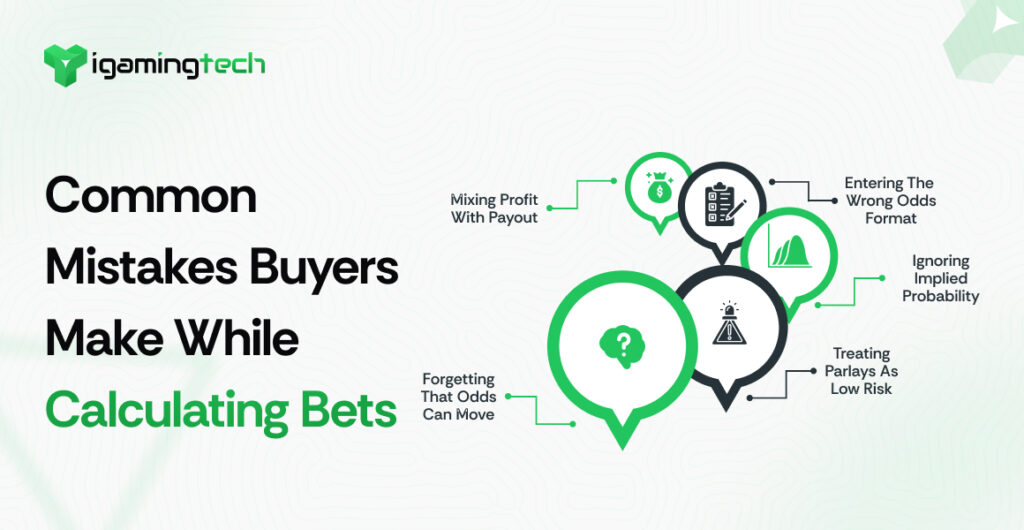
Common Mistakes Buyers Make While Calculating Bets
Bet calculations can look simple at first. Small input errors can still change the final result. A betting odds calculator helps reduce mistakes, but users still need to understand what each value means before they place a wager.
1. Mixing Profit With Payout
Many users confuse profit with total payout. Profit is the amount earned after removing the original stake. Payout is the full amount returned after a winning bet.
- Profit shows the actual winning amount
- Payout includes stake and profit
- A high payout does not always mean high profit
- Clear separation helps users judge bet value better
2. Entering The Wrong Odds Format
The wrong odds format can lead to wrong return values. A user may enter American odds where decimal odds are required. This can create a misleading payout result.
- Check the odds format before calculation
- Use American decimal or fractional odds correctly
- Avoid mixing odds types in one input field
- Review the result before placing the wager
3. Ignoring Implied Probability
Some users only look at the possible return. They may ignore the chance suggested by the odds. This can make high return bets look safer than they are.
- Implied probability shows market expectation
- Higher odds often suggest a lower winning chance
- Return value should not be the only factor
- Better probability reading supports smarter decisions
4. Treating Parlays As Low Risk
Parlays can show attractive payouts. The risk also increases with every added selection. One losing selection can usually make the full bet lose.
- More selections can increase returns
- More selections also increase risk
- Every leg must usually win
- Users should review the full parlay before betting
5. Forgetting That Odds Can Move
Odds can change before a bet gets confirmed. A user may calculate a return based on old odds. This can create confusion when the final payout looks different.
- Odds can move before bet placement
- Live markets can change faster
- Users should refresh odds before confirming
- Final payout should match the accepted odds
Conclusion
A sports betting calculator helps users understand a wager before they place it. It shows possible profit and total payout odds value in a clear way. This removes guesswork and helps users make better planned betting decisions.
The tool does not guarantee a winning result. It only explains what a bet can return if it wins. For users, it adds clarity before stake placement. For betting businesses, it can improve trust and create a smoother product experience.
Connect with us today and build your betting calculator.
Ready To Build Your Own Sportsbook Platform?
Launch a secure, scalable, and fully integrated sportsbook designed to grow your business faster.


