
Modern sportsbooks rely on several connected systems to manage betting operations. Odds feeds supply current market prices. Wallet services reserve player funds. Trading tools apply risk rules. Settlement services grade results and issue payouts. Each system must exchange accurate data in the correct order. A delayed response or mismatched record can suspend a market or reject a valid wager. Operators need a clear integration plan that defines data ownership, response times, and failure handling before development starts.
This guide explains API types and architecture choices. It also covers development requirements and cost factors, technical challenges, and proven implementation practices.
What Is Sportsbook API Integration?
A sportsbook Application Programming Interface (API) gives software systems a defined method for exchanging data and triggering actions. Sportsbook API integration connects these interfaces to the core betting platform. It allows the platform to request odds, submit wagers, update balances, and settle results through structured requests.
Sports betting API integration does not provide a complete sportsbook on its own. Each API supports a specific function. A full sportsbook platform also includes the player interface, betting engine, back office controls, and account management tools. Building these connected components requires a structured sports betting software development approach that combines APIs with reliable platform architecture. The operator must connect these components through a coordinated architecture to maintain accurate records and reliable betting workflows.
A sportsbook API is different from a complete sportsbook platform. An API focuses on specific capabilities. However, a full platform includes the betting interface, management tools, and other core components required to run a sportsbook.
How Sportsbook API Integration Works Behind The Scenes
A sportsbook API workflow moves through several stages before a wager reaches completion. Each stage handles a specific task within the overall betting lifecycle.
1. Data Input
The workflow begins when the sportsbook receives event details, market information, and other relevant data through connected sources.
2. Market Preparation
The received data is organized and prepared for display. The sportsbook applies the required rules to create available markets and betting options.
3. Wager Validation
When a user places a wager, the request goes through validation checks. The system reviews account status, selected market details, and applicable rules before approval.
4. Activity Tracking
After confirmation, wager details are recorded and monitored throughout the event. This allows the sportsbook to maintain accurate records during the betting lifecycle.
5. Outcome Settlement
After the event ends, the final result is applied to completed wagers. The settlement engine updates outcomes and completes the remaining actions.
This workflow shows how different sportsbook components work together to deliver a consistent user experience.
Core APIs Required For A Modern Sportsbook Platform

A sports betting platform API supports different functions based on the type of data or action required inside the sportsbook ecosystem. Each API connects to a specific part of the betting ecosystem. The integration approach depends on how these services share information, respond to requests, and handle changes during live activity.
Sports Data API
A Sports Data API supplies the event information required to build sportsbook markets. This includes competitions, participants, schedules, statistics, and match status. Operators can use a sports stats API to collect structured match data and connect it with sportsbook workflows.
The main technical challenge is data mapping. A sports data provider may use its own event IDs and competition structures. The sportsbook needs to map this information into its internal model so that odds, bets, and results refer to the same event.
Incorrect mapping can create issues such as duplicate events or incorrect result associations.
Odds Feed API
An Odds Feed API delivers pricing information for available markets. It is responsible for transmitting pre-match and live odds changes during an event.
Live betting requires frequent updates because odds can change within seconds. The integration needs to handle update speed, timestamps, market suspension, and reopening of available selections.
Many providers use push based updates or polling methods to deliver changes. A reliable odds feed API integration helps sportsbooks receive updated market prices and manage live betting requirements more efficiently.
Betting API
A Betting API connects the bet slip with the wagering engine. It carries information such as account details and market selections. It also stores odds and stake values when a user submits a wager.
Before accepting a bet, the wagering flow checks the current market status. They review available balance, odds validity, and stake limits. If the request fails or times out, the system needs a clear response process.
Idempotency controls are also important. They prevent duplicate bets when a user retries a request after a connection failure or delayed response.
Wallet API
A Wallet API connects betting activity with account balances and financial records. It manages actions such as stake deductions, winnings updates, and transaction history.
The key challenge is maintaining a consistent balance state. A typical flow involves bet acceptance and stake deduction. The process also involves transaction recording and possible reversal if the wager fails.
Player Account API
A Player Account API connects user identity and account information with the sportsbook. It commonly handles authentication details and session information.
Sportsbook integrations may also require account related checks such as KYC status, jurisdiction eligibility, or self exclusion rules.
Settlement API
A Settlement API connects final event results with completed wagers. It receives result information and matches it with stored bet records.
The workflow includes result validation, bet status updates, payout calculation, and account balance adjustments.
Settlement systems also need to handle corrections. A result may change after the initial update. The integration should support adjustments without affecting historical records.
Reporting API
A Reporting API combines information collected across different sportsbook services. It can include bet records, wallet transactions, settlements, user activity, and provider responses.
The main challenge is data normalization. Information from different APIs often follows different structures. Reporting systems need to organize this data into a consistent format for analysis and reconciliation.
This allows teams to review betting history, financial records, and system activity from a unified data source.
Transform Betting Ideas Into A Scalable Sportsbook Solution —Start Your Integration
Contact Us
Sportsbook API Architecture Explained
Sportsbook software integration determines how the betting interface exchanges data with internal services and external providers. Each connection follows a defined request format and response format. The platform may receive live odds while it validates wagers, checks accounts, and settles results. The integration structure must prevent these actions from creating delayed updates or conflicting records.
Bet Placement Flow: How a Wager Moves Through the Architecture
When a bettor confirms a wager, the request moves from the bet slip to the Application Programming Interface (API) gateway. The API gateway acts as the secure entry point for platform requests. It verifies the request and sends it to the wagering service.
The wagering service checks the event identifier, market status, current odds, stake limits, and available account balance. It rejects the request if the market has closed or the price has changed beyond the permitted range.
The request may also pass through risk controls before approval. Once accepted, the wallet service records the stake deduction, and the sportsbook creates a bet record with details such as the event ID, selection, odds, and acceptance time.
This flow requires controlled handling because a delayed response or duplicate request can create mismatched bet records.
Odds Update Flow: How Live Markets Reach Users
Live odds follow a different path than wager requests.
The odds provider sends market changes to the integration layer through API requests or real time data streams. The integration service converts the provider format into the sportsbook’s internal market structure.
The updated information then moves to the market service and reaches users through real time channels such as WebSocket connections.
This approach prevents the frontend from directly depending on external providers. It also allows the sportsbook to control which markets and prices are displayed.
Frontend Layer: Consuming Normalized Sportsbook Data
The frontend displays markets, odds, bet selections, and account information to users. It does not usually communicate directly with every external provider.
Instead, it receives processed data through internal APIs. This keeps provider specific formats, authentication methods, and data conversion logic within backend services.
A normalized data structure allows the frontend to display information consistently even when multiple providers are involved.
API Gateway Layer: Managing Different Request Types
The API gateway acts as a controlled entry point for requests moving between different sportsbook components.
Not every request requires the same treatment. A bet placement request requires validation and transaction checks. A market request may require frequent data retrieval. A provider webhook may deliver automated updates from external services.
The gateway manages authentication, routing, request limits, and version control based on the type of traffic it receives.
Backend Services Layer: Separating Sportsbook Functions
The backend separates different sportsbook functions into dedicated services.
The odds service focuses on market information and price changes. The betting service handles wager validation and acceptance. The wallet service manages financial records. The account service manages user status and restrictions. The settlement service applies final event results.
This separation prevents high frequency activities such as odds updates from interfering with transactional actions such as bet placement or wallet changes.
Integration Layer: Connecting External Providers
Sports betting API integration requires this layer to handle provider data mapping, authentication methods, and different response formats before the information reaches internal sportsbook services.
Common integration paths include:
- Sports data provider to event service
- Odds provider to market service
- Payment provider to wallet service
- KYC provider to account service
This layer manages data mapping, webhook events, authentication details, and provider specific responses. Operators looking for faster market entry can consider white label sports betting software with existing integrations and configurable sportsbook features.
Data Layer: Separating Transaction Records And Live Data
A sportsbook stores different types of information that require different handling methods.
Transactional data includes bets, wallet movements, account changes, and settlement records. These records require consistency because they affect financial and user history.
High frequency data includes odds changes, market status, and live event updates. This information requires faster updates because conditions can change during an event.
Separating these data requirements helps prevent live market activity from affecting critical transaction records.
The key architectural distinction is the difference between continuous market updates and controlled transactional requests. Live odds can change multiple times during an event, while wagers, wallet actions, and settlements require precise state changes at each step.
Sportsbook API Integration Process: From Planning To Launch
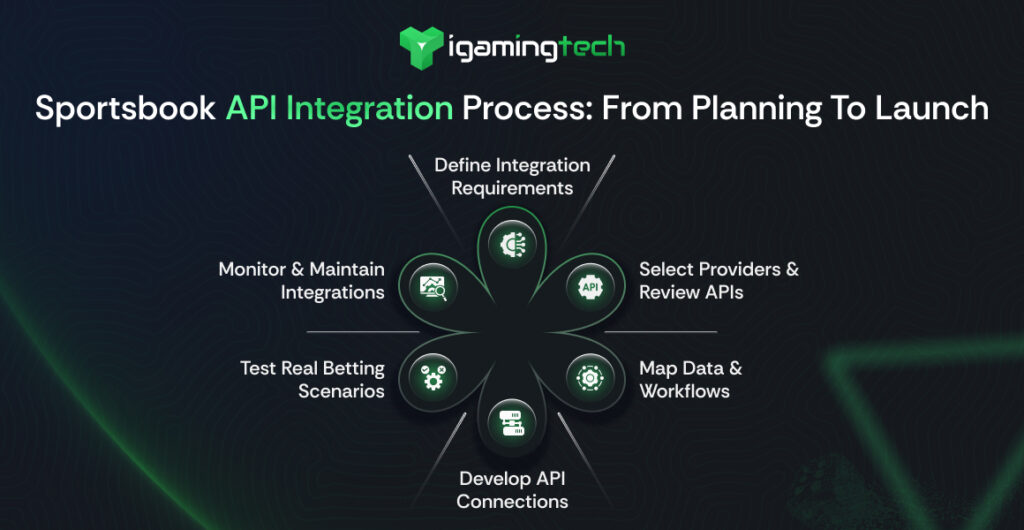
A sportsbook API integration project starts with clear planning. The team first defines the required features, data sources, and technical goals. This step creates a clear direction before development begins.
1. Define Integration Requirements
The team identifies the functions the sportsbook needs to support. This can include sports coverage, betting markets, live betting, account features, payment workflows, and compliance needs.
The team also decides which functions require external APIs and which parts should remain within the internal system. This helps avoid unnecessary connections and keeps the integration scope clear.
2. Select API Providers And Review Documentation
API provider selection requires more than comparing features. The team reviews documentation, available endpoints, authentication methods, data formats, and testing options.
Clear documentation helps developers understand how requests and responses work. It also reduces issues during implementation.
3. Map Data Structures And API Workflows
External providers often use different formats for the same information. The integration team maps provider data into the sportsbook structure.
This includes event IDs, competitions, markets, selections, and status updates. Proper mapping keeps information consistent across different stages of the betting lifecycle.
4. Develop API Connections
Developers configure authentication and build the required API requests. They also create response handling rules for different scenarios.
The integration needs to handle failed requests, delayed responses, provider timeouts, and unexpected data changes. Error logs help teams identify issues during development and after launch.
5. Test Real Betting Scenarios
Testing should cover real situations instead of only successful requests.
The team checks scenarios such as odds changing after a user selects a market, unavailable markets, rejected wagers, failed wallet actions, and corrected event results.
These tests reveal issues that standard functionality checks may not detect.
6. Monitor And Maintain Integrations
API integration needs active maintenance after launch. Providers can retire endpoints, change response fields, or release a new API version. Each change can break data mapping or disrupt a connected workflow.
The team should track response times, failed requests, and webhook errors. Automated alerts should identify unusual activity before it reaches bettors. The team should also test provider updates in a sandbox before deploying them to the live platform.
How To Choose The Right Sportsbook API Provider
Choosing a sportsbook API provider requires more than comparing market counts. The operator must assess data coverage, delivery speed, integration effort, security controls, and contract terms. The selected provider must also support the planned regions and betting products.
Data Coverage Check
The operator should compare the provider catalog with the sportsbook launch plan. The review should confirm each required sport and competition. It should also cover pre-match markets, live markets, and settlement data.
A large market count can create a misleading impression. The feed offers little value if it excludes local competitions or provides limited live coverage for the target audience.
API Delivery Check
Delivery methods determine how quickly the sportsbook receives new information. Representational State Transfer (REST) endpoints support scheduled requests. Streaming connections deliver continuous updates. Webhooks send automatic messages when a specific event occurs.
The operator should measure update speed, response latency, and connection stability. The review should also confirm rate limits and reconnection behavior after an outage.
Documentation and Testing Check
API documentation should explain authentication, endpoint behavior, and request formats. It should show complete response samples and error codes. It should also document rate limits and version changes.
The provider should offer a sandbox with realistic test data. This environment allows the team to validate mappings and failure responses before connecting the API to live sportsbook services.
Security Check
The security review should examine how the provider protects access and sensitive data. The provider should use Transport Layer Security (TLS) to protect data during transmission. It should also support access tokens with limited lifetimes and signed webhook messages.
The operator should confirm access controls, audit logs, and data retention rules. These controls must align with the compliance requirements of each target market. A wider sports betting app security strategy helps protect user accounts and financial workflows connected with sportsbook systems.
Reliability And Support Check
Provider reliability depends on more than uptime claims. Operators should review service level agreements (SLAs), incident communication methods, maintenance notifications, and API change policies.
Clear communication around updates and version changes helps teams prepare for modifications without unexpected disruptions.
Commercial Fit Check
The provider’s pricing model should match the sportsbook’s expected usage. Operators should review licensing structures, usage limits, additional charges, and contract terms before making a decision.
A suitable provider should offer the required technical capabilities while fitting the long term business model of the sportsbook.
Connect The Right Technology For Your Sportsbook Future —Discuss Your Project
Contact Us
Sportsbook API Integration Cost Factors
Sportsbook API integration costs usually come from several areas, including provider fees, development work, infrastructure needs, testing, and ongoing maintenance. The final cost depends on the number of services involved and the amount of custom logic required around those connections.
API Provider and Data Costs
API provider fees often depend on the type of data included in the service. Factors such as live odds coverage, market depth, historical data, sports availability, and regional coverage can affect pricing.
Operators also need to consider how the provider structures access. Some services may charge based on usage volume, available features, or specific data packages.
Integration Development Costs
Each external service requires technical work before it can function within the sportsbook architecture. This includes authentication setup, data mapping, request handling, and response processing.
Multiple providers can increase development effort because each connection may use different formats, identifiers, documentation standards, and update methods.
Custom Development Requirements
Standard API connections usually involve configuration and data mapping. Custom requirements may require additional development work.
Infrastructure and Operational Costs
API integration also requires supporting infrastructure. The sportsbook may need resources for API gateways, databases, caching systems, message queues, monitoring tools, and real time communication services.
Live betting environments may require additional infrastructure planning because odds updates can create high volumes of incoming data that need fast processing.
Testing and Quality Assurance Costs
Testing costs depend on the number of workflows and failure scenarios that need validation.
Sportsbook integrations require testing for situations such as rejected wagers, delayed provider responses, changing odds, wallet errors, and settlement corrections. Multiple connected services also require combined testing to confirm that data moves correctly across the complete workflow.
Maintenance and Update Costs
API integration requires ongoing technical work after launch. Costs may include provider updates, schema changes, security improvements, monitoring, troubleshooting, and compatibility checks.
External services can change over time. The sportsbook needs regular updates to maintain stable connections and prevent unexpected issues.
Architecture and Technical Complexity
The existing architecture can influence implementation effort. A modular sportsbook with defined service boundaries may require fewer changes when adding new integrations.
A tightly connected system may require updates across multiple services, databases, and user workflows. This can increase development effort and regression testing requirements.
Understanding these cost factors helps operators plan their sportsbook API development approach with clearer expectations around technical requirements and long term maintenance.
Common Sportsbook API Integration Challenges
Betting API integration requires careful handling of data mapping, wager requests, and external service responses. The main challenges appear when different systems use different formats or when betting activity changes quickly.
Data Mapping Issues
External providers may structure the same information differently. One provider may use its own event ID while another system uses a different identifier for the same match.
The integration layer needs to match events, markets, selections, and status values correctly. Poor mapping can create incorrect odds, missing markets, or settlement errors.
Real-Time Data Delays
Live betting depends on fast market updates. A delay can cause users to see outdated odds when they try to place a wager.
The sportsbook needs to handle delayed messages, connection issues, and market changes. It also needs rules for updates that arrive after a market status has changed.
Bet Validation Failures
A wager request can fail after a user selects a market. The odds may change. The market may close. The stake may exceed the allowed limit.
The sportsbook needs clear responses for accepted, rejected, and pending wagers. It also needs to handle provider timeouts without creating incorrect bet records.
Duplicate Transactions And Wallet Issues
Wallet actions require careful tracking because they affect user balances. A delayed response can cause a user to retry a request. Without proper controls, the same transaction may be processed more than once.
Unique request IDs and transaction records help prevent duplicate wallet actions and balance issues.
Provider Dependency Risks
External providers can affect sportsbook availability. API downtime, format changes, and version updates can create unexpected issues.
The integration needs monitoring and error handling. Teams also need a process for managing provider changes before they affect users.
Scaling During High Traffic Events
Major sporting events can increase user activity and market updates within a short period. The sportsbook needs to handle higher traffic without slowing down important actions. Live data updates and financial transactions should use separate handling paths to avoid performance issues.
Sportsbook API Integration Best Practices
A successful sportsbook API integration depends on how well the different connections are planned, tested, and maintained. The right practices help teams avoid data issues, failed requests, and workflow errors during daily sportsbook activity.
Use A Clear Data Mapping Strategy
External providers often use different formats for events, markets, and selections. A clear mapping strategy helps the sportsbook match external data with its internal structure.
The mapping process should define rules for event IDs, market names, selection details, and status changes. This reduces issues such as incorrect market references or mismatched settlement records.
Separate Live Data And Transaction Workflows
Live odds updates and financial actions have different technical requirements. Odds data may change multiple times during an event. Bet placement and wallet actions require controlled transaction handling.
Keeping these workflows separate helps prevent high volume market updates from affecting critical actions such as wager confirmation or balance changes.
Build Strong Error Handling
API connections can face failed responses, timeouts, and unexpected data formats. The integration should have clear handling rules for these situations. Error logs, retry controls, and response tracking help teams identify issues and prevent repeated requests or missing records.
Maintain API Documentation And Version Control
External APIs can change over time. Providers may update endpoints, response formats, or available features. Internal documentation should record API versions, connection details, and integration changes. This gives developers a clear reference when updates are required.
Test Real Betting Scenarios Regularly
Testing should reflect actual sportsbook conditions. Basic connection checks are not enough. Teams should test situations such as changing odds, suspended markets, rejected wagers, failed wallet actions, and corrected settlement results. These scenarios help identify problems before they affect users.
Monitor API Performance And Data Quality
Monitoring helps teams identify integration issues early. Important areas include failed requests, delayed responses, missing data, and unexpected changes in provider output. Regular checks on API activity and data quality allow teams to address issues before they impact sportsbook functions.
Conclusion
Sportsbook API integration requires careful planning across data connections, architecture, development, and ongoing maintenance. The right approach depends on the sportsbook requirements, provider capabilities, and level of customization needed.
A successful implementation goes beyond connecting APIs. It requires accurate data mapping, clear workflows, proper validation, and reliable handling of changes across different services.
Operators should evaluate each integration decision based on long term product goals. The right API structure can support flexible sportsbook development while keeping technical complexity under control.
A well planned integration strategy gives teams a stronger foundation for managing sportsbook features, adding new services, and adapting to future requirements.
Ready To Build Your Own Sportsbook Platform?
Launch a secure, scalable, and fully integrated sportsbook designed to grow your business faster.


