
A sportsbook app displays markets and captures player instructions. The visible screen is only the entry point. Each wager reaches several systems before the platform can accept it. The betting engine checks the market and price. The risk layer checks exposure, the wallet reserves the stake, and the transaction record then preserves the accepted terms for settlement.
Sportsbook App Development therefore starts with operating decisions rather than interface design. The operator must define the launch jurisdiction. Pricing responsibility needs a clear owner. Data and payment providers need approval before integration work begins. The business must also decide which technology and records remain under its control. These choices determine the build scope and launch requirements.
What Sportsbook App Development Actually Covers
A sportsbook app does more than display markets and collect betting instructions. Every player action moves into a connected platform that checks its validity and financial effect. This wider scope separates sportsbook software development from ordinary mobile product work. Operators evaluating sports betting app and software development must therefore define every system involved in processing a wager.
|
Product layer |
Main responsibility |
| Player application | Displays events and captures betting instructions |
| Sports data layer | Receives current fixtures and market prices |
| Betting engine | Validates prices and records accepted wagers |
| Risk controls | Applies limits and manages operator exposure |
| Wallet ledger | Records stakes and payouts and refunds |
| Settlement engine | Resolves wagers against confirmed results |
| Operator back office | Manages users and markets and transaction records |
Each layer needs a distinct role because unclear boundaries can create conflicting records. The application may display the outcome. However, the server-side platform must remain the authoritative record for prices, balances, and wager status.
Planning a Custom Sportsbook App? —Let's Build It
Contact UsSeven Decisions That Set the Build Before the First Sprint
Before Sportsbook App Development enters the first sprint, the operator needs seven written decisions. Each one closes a commercial or regulatory question that could block design approval or vendor onboarding later.
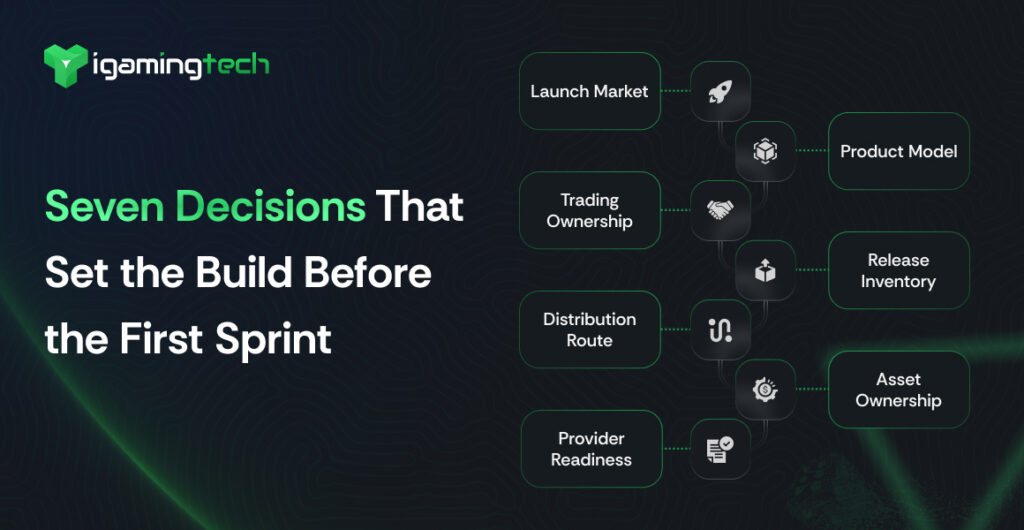
1. Launch Market
Select the first jurisdiction and confirm the required license category. This allows the product team to check permitted wagering models and mandatory player controls against one defined market.
2. Product Model
With the market confirmed, the operator can choose fixed odds, exchange betting, or pool betting. This choice establishes who carries liability and how the product earns revenue.
3. Trading Ownership
Once the model is clear, the business must assign pricing and exposure management. The agreement must state who can override prices and suspend markets.
4. Release Inventory
The trading arrangement then guides which sports, competitions, and wager types can enter the first release. Every promised market must match confirmed provider coverage.
5. Distribution Route
The release plan must also identify iOS, Android, and mobile web requirements. Licensed territories and application store eligibility can limit where each channel becomes available.
6. Asset Ownership
Before development agreements are signed, the operator must assign ownership of source code, cloud accounts, application listings, and operational data.
7. Provider Readiness
Finally, the operator must confirm provider contracts, documentation, and sandbox access dates. Delayed access can stop integration work even after the product design receives approval.
These choices belong in a Product Requirements Document (PRD). The PRD becomes the approved reference for design, engineering, and vendor coordination throughout delivery.
Custom or White Label: Decide What the Operator Must Own
After defining the product model, the operator must decide where technical control will sit. A custom build creates product-specific code around the approved operating rules. A white label setup uses a provider-owned core that the operator configures and brands. The real difference becomes clear when the business needs to change a provider or release a new function or leave the original vendor.
Decision factor |
Custom development |
White label delivery |
| Source code | Ownership and repository access can be defined by contract | The core code usually remains with the provider |
| Release control | The operator sets priorities and deployment timing | Changes may follow the provider’s release schedule |
| Provider choice | Integration adapters can connect selected vendors | Available vendors may come from an approved catalog |
| Data access | The operator can define raw data and export access | Access depends on available reports and interfaces |
| Local changes | Rules can follow one market’s exact requirements | Changes depend on existing configuration options |
| Operating duty | The operator funds maintenance and technical support | The provider maintains the shared platform core |
| Exit planning | Controlled assets can move with the business | Data export and migration terms need early agreement |
| Commercial model | Costs center on engineering and infrastructure | Charges can include setup fees and recurring fees |
Operators can compare custom vs ready-made sports betting software before committing to one delivery route. Custom sportsbook app development becomes valuable when control over releases and integrations justifies the ownership burden. A business prioritizing quicker configuration can review white label sports betting software while checking provider limits and exit terms.
How the Platform Processes a Wager From Submission to Settlement
A wager moves through a fixed transaction sequence. Each stage receives defined information and returns a recorded status before the next stage begins. A $50 bet at decimal odds of 2.10 shows how this sequence works. Decimal odds represent the total return for each unit staked.
Selection Request
The app sends the account reference, selection reference, and displayed price and stake. A unique request identifier connects every later status check to that submission.
Market Validation
The betting engine reads the current market version and accepted price. A changed price creates a new price prompt. A suspended selection ends the request as rejected.
Exposure Check
Once the market remains valid, the risk rules compare the stake with the player limit and operator exposure. Only an approved request can reach the wallet.
Fund Reservation
The wallet reserves the $50 stake and records the balance movement. This reservation prevents the same funds from supporting another wager before final acceptance.
Wager Confirmation
The platform records the accepted odds and stake, potential return, and transaction time. The app receives a unique bet identifier only after this record exists.
Result Settlement
The settlement engine applies the confirmed result to the stored market rule. It marks the wager as won, lost, or void. The wallet then records the payout or refund.
In sports betting platform development, each status becomes a controlled state with one permitted next action. The interface can display that status but cannot override the financial record.
Confirm Third-Party Provider Requirements Before Integration
External services create fixed technical and commercial boundaries. The operator needs more than access credentials before sportsbook software development reaches integration work. Each provider must supply approved coverage, data definitions, test access, and production terms. An Application Programming Interface (API) defines how two systems exchange this information.
Market Data Contract
The odds contract must name supported sports, competitions, and markets. It must also define update frequency and usage limits. A documented odds feed API integration then maps provider event identifiers and market identifiers into the internal data model.
Result Authority
The operator must identify which provider supplies the official result for settlement. The agreement also needs a correction policy for abandoned events and disputed outcomes and revised results.
Trading Boundary
A managed trading agreement must assign control over price changes, market suspensions, and manual overrides. It must also identify which party monitors exposure and approves exceptional wagers.
Verification Route
Know Your Customer (KYC) verifies player identity. Anti-Money Laundering (AML) systems assess financial risk. Their integration requirements must define country coverage, response codes, and manual review routes. The geolocation provider must also confirm device support and permitted territories.
Payment References
Each payment response needs a unique external transaction reference. That reference allows the operator to compare deposits and withdrawals with wallet records during reconciliation. Provider reports must use the same identifiers as the transaction interface.
Downstream Events
Customer relationship management tools, notification services, and analytics platforms can receive approved platform events. They must not decide wager status or wallet balances. A delayed marketing message cannot alter an operational record.
Replacement Readiness
A provider-neutral connection layer keeps external rules outside the core product logic. This approach allows sports betting platform development teams to replace a provider without rewriting unrelated services. The sportsbook API integration plan must also document data exports, service closure terms, and migration access.
Plan Sportsbook Mobile App Development for Live Match Conditions
Live betting creates frequent changes in connection quality and session state. The mobile design must define what the user sees after an app switch or an interrupted request.
Restore the Session
When the app returns to the foreground, it should verify that the session remains valid. An expired session should trigger authentication before the user can place another bet. The app can then retrieve the latest account state without discarding the user’s previous navigation context.
Preserve the Betslip
A temporary connection loss should not erase an unsubmitted betslip. The app can retain its selections on the device. It must revalidate their availability after reconnection.
A changed price should require the response defined by the operator’s acceptance policy. A suspended market should become unavailable. The app must never submit stale selections automatically.
Resolve an Interrupted Submission
A connection may fail after the user taps the bet button but before confirmation reaches the device. The app should keep the request identifier and use it to check the outcome.
Any retry must use that same identifier. This allows the transaction service to return the existing result instead of creating a second wager. The interface should show a pending state until it receives an accepted or rejected response.
Synchronize Devices Deliberately
The operator must decide which temporary preferences follow the user across devices. These may include saved selections and favourites. Version numbers or update times can resolve conflicting changes when two devices modify the same item.
Protect Device Access
Biometric authentication can simplify access on a recognised device. Sensitive actions may still require full authentication when the session has expired, or the device risk level has changed. Session credentials should remain in protected device storage.
Treat Notifications as Alerts
Push notifications may arrive late or in the wrong order. Opening an alert should take the user to the relevant screen and trigger a status refresh. The notification itself should never determine the displayed wager outcome.
Enforce Compatible Versions
The operator should define a minimum supported app version. A mandatory update becomes necessary when an older release cannot support a required security rule or transaction response. Less critical releases can use an update prompt with a defined grace period.
These behaviours make sportsbook mobile app development resilient to the interruptions users experience during live events. They also strengthen the sportsbook user experience by keeping every action and outcome clear after a connection or session change.
Convert Jurisdiction Rules Into Testable Product Controls
A legal requirement becomes usable only after the team defines the matching action and failure state. Each rule also needs clear evidence that testers and compliance reviewers can verify before launch.
|
Regulatory condition |
Product control |
Acceptance evidence |
| Age and identity | Deposit and betting access remain locked until required checks pass. An inconclusive result enters manual review. A failed result keeps the account restricted. | Approved test accounts demonstrate passed, failed, and pending outcomes. |
| Licensed location | Location checks run at the points required by the jurisdiction. The platform blocks wagering when the user is outside the permitted area or the location cannot be verified. | Tests cover valid locations, border areas, blocked territories, and location manipulation attempts. |
| Financial limits | Deposit. stake. or loss limits use the required calculation period and local time zone. Any cooling-off rule controls when an increase becomes active. | Tests cover limit changes, period resets, pending transactions, and blocked payments. |
| Self-exclusion | The restriction applies across every product connected to the same player account. It also stops promotional messages where the applicable rules require this action. | One excluded test account confirms the restriction across devices and product categories. |
| In-play warnings | Required delay information appears near live betting activity. It cannot remain hidden inside general terms. UK Gambling Commission standards address technical disadvantages caused by network speed or device performance. | Reviewers verify the warning on supported screen sizes and connection states. |
| Regulatory reporting | Wager history and wallet activity retain the required timestamps, state changes, account references, and manual adjustments. Export fields match the regulator’s submission format. | A sample report reconciles against the related account and financial activity. |
| App distribution | Storefront access matches the approved licence territories. Apple requires real-money gaming apps to hold the necessary permissions, remain geo-restricted, and be free on the App Store. Google Play also requires licensing for each distribution territory and effective geographic restrictions. | Store settings and in-app access controls are tested separately before submission. |
Six Approval Checks for the Sportsbook App Development Process
An approval check prevents incomplete work from moving into the next stage. Each check requires defined evidence and a named approver. It also defines when a later change must reopen an earlier decision.
1. Scope Approval
The team approves one version of the Product Requirements Document. Any later request must show its effect on delivery time, provider agreements, testing effort, and release scope.
2. Provider Approval
Integration begins after developers receive credentials, sample payloads, rate limits, and failure codes. The review also confirms how the connection responds to throttling, timeouts, and unavailable services.
3. Transaction Approval
A controlled test pack covers accepted, rejected, pending, retried, voided, and corrected wagers. Balance totals must reconcile after each scenario. Reused request identifiers must return the existing outcome instead of creating another wager.
4. Mobile Approval
Tests run across supported devices and operating system versions. Evidence covers network switching, session recovery, interrupted submissions, restored betslips, and mandatory app updates.
5. Compliance Approval
Each jurisdiction rule receives a control identifier, test result, responsible owner, and evidence location. A failed control must block the restricted action instead of displaying a warning while allowing it to continue.
6. Production Approval
The final release requires verified monitoring alerts, rollback instructions, access roles, backup restoration, and incident ownership. The approved version then enters a release freeze so untested changes cannot reach production.
This structure makes the sportsbook app development process measurable through approved outcomes instead of completed task lists.
Test What Happens When Bets or Payments Go Wrong
The test plan must force situations that normal user journeys rarely create. Every scenario needs one expected transaction state and a matching financial outcome.
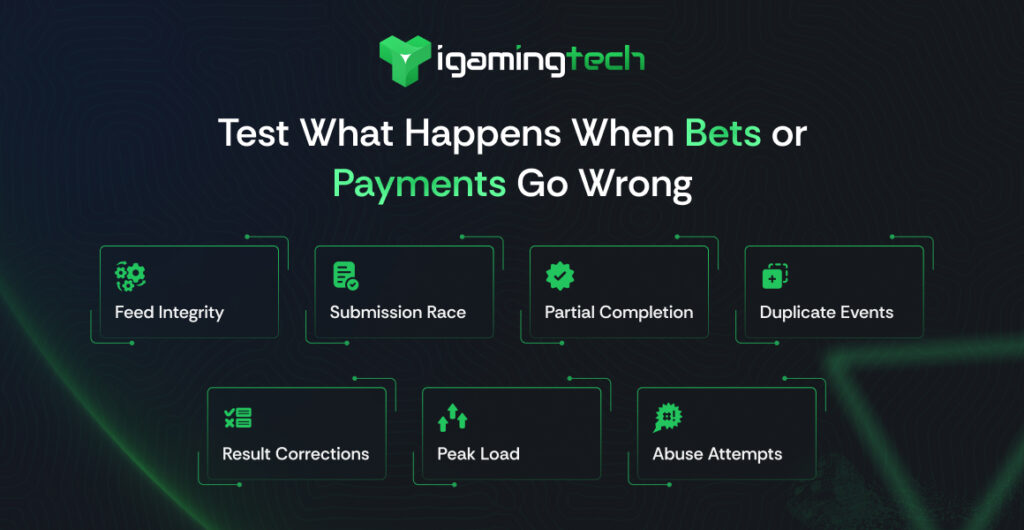
Feed Integrity
Testing sends a newer odds update before an older one. The platform must retain the newer sequence and reject the late message. A separate test stops the live feed and confirms that affected markets suspend after the defined heartbeat limit.
Submission Race
The test pauses a wager request and suspends its market before commitment. The request must return a rejection. Any temporary fund authorization must also be released through the same transaction reference.
Partial Completion
Another scenario reserves the stake but interrupts wager confirmation. Recovery logic must check if the wager exists before completing or releasing the authorization. This prevents unresolved holds and unmatched wagers.
Duplicate Events
Idempotency means that repeated delivery produces one outcome instead of another transaction. Tests resend wager requests and payment callbacks with the same identifier. Only the first valid event can change the transaction state.
Result Corrections
Testing first settles a wager and then submits a corrected or void result. The adjustment must reference the original settlement. The final balance must reconcile without deleting the earlier decision.
Peak Load
Load testing applies a sudden traffic increase during a scheduled event. The test measures response times against approved limits. It also confirms that reporting or notification tasks cannot consume resources reserved for wager and payment actions.
Abuse Attempts
Security testing modifies stakes, replays session tokens, changes account references, and requests restricted administrator actions. The sportsbook app security checklist can help define coverage for these attack paths.
A release passes this section only when each failure produces the approved state and every financial difference can be reconciled.
Need a Scalable Sportsbook Platform? —Talk to Our Experts
Contact UsCalculate Sportsbook App Development Cost From Scope and Dependencies
The cost of sportsbook app development depends on the operating model selected before coding begins. A fixed cost estimate cannot be accurate until the operator defines ownership level, provider contracts, target markets, and required transaction flows.
A custom platform usually requires higher upfront investment because the operator owns the application logic, integrations, infrastructure setup, and long-term maintenance responsibility. A white label model can reduce initial development work but may introduce recurring platform fees and provider limitations.
Development Scope
The first cost factor is the product scope. A basic betting application with pre-match markets requires fewer components than a platform supporting live betting, multiple sports, advanced bet types, player segmentation, and automated risk controls.
The number of platforms also affects delivery effort. iOS, Android, and mobile web releases require separate testing cycles and distribution requirements.
Provider Expenses
Third-party services create ongoing operational costs. These may include sports data feeds, odds providers, payment gateways, identity verification services, geolocation tools, and risk management solutions.
Each provider agreement can include setup fees, usage limits, transaction charges, or recurring subscription costs.
Compliance Requirements
Regulated markets add compliance-related expenses. These costs depend on the jurisdiction and may include licensing support, certification requirements, reporting systems, responsible gaming controls, and audit preparation.
A product designed for multiple regions usually requires additional rule configuration and testing.
Infrastructure Planning
Infrastructure costs depend on expected traffic and transaction volume. Live betting periods require higher capacity because thousands of users may interact with markets at the same time.
The operator must also consider monitoring tools, backup systems, security controls, and disaster recovery planning.
Long-Term Maintenance
Launch does not complete the investment cycle. Sportsbook platforms require ongoing updates for operating systems, provider changes, regulatory updates, security improvements, and new product requirements.
Define Ownership and Operating Duties Before Handover
A successful sportsbook launch requires more than a completed application. The operator must receive clear ownership rights and operational responsibilities before the platform moves into production.
Source Code Access
The agreement must define who owns the application code, repositories, development history, and deployment processes. This prevents future restrictions when the operator needs updates or new integrations.
Cloud Control
Cloud ownership determines who manages servers, databases, storage, and access permissions. Operator-controlled cloud accounts provide direct control over infrastructure decisions.
App Store Accounts
The operator should own Apple and Google developer accounts. These accounts control application publishing, updates, compliance communication, and store visibility.
Data Ownership
Player records, transaction history, wager information, and reporting data require clear ownership terms. The operator must know where data is stored and how exports are handled.
Monitoring Responsibility
Production monitoring needs assigned ownership. The team must define who reviews system alerts, investigates failures, and manages incidents after launch.
Support Structure
Post-launch responsibilities must identify who handles bug fixes, security updates, provider changes, and feature improvements. Clear support terms prevent delays when operational issues appear.
Conclusion
Building a sportsbook app requires decisions that extend beyond interface design. Operators need clear ownership rules, provider strategies, compliance controls, transaction workflows, and long-term operating plans before entering development.
A structured sportsbook app development process reduces delivery risks because every major decision receives approval before implementation. It also creates a clearer path for scaling the platform after launch.
iGamingTech helps operators plan and build sportsbook solutions with defined architecture, controlled integrations, and ownership-focused delivery models.
Ready To Build Your Own Sportsbook Platform?
Launch a secure, scalable, and fully integrated sportsbook designed to grow your business faster.


