
Building a fantasy sports app like FanDuel requires more than copying visible screens and contest formats. A reliable product needs clear game rules. It also needs live sports data and accurate scoring. Secure payments and user verification protect every contest. Strong infrastructure keeps the platform stable during traffic spikes. The fantasy sports app development process must connect product planning with legal review and technical execution. Cost changes with the number of sports and platforms. It also depends on contest complexity and third party integrations. This detailed guide explains the required features and development steps. It also covers technology choices and cost factors that shape a successful launch.
What Is a FanDuel-Style Fantasy Sports App?
A FanDuel style platform lets users create virtual teams with real athletes. Daily Fantasy Sports (DFS) contests usually run for one game day or a short event period. Each athlete earns fantasy points based on real match performance. The platform applies fixed scoring rules and updates user rankings as live data arrives. Users can join public contests or create private contests with selected participants. Some formats use a salary cap that limits the total value of chosen players.
Fantasy sports software development focuses on team selection and scoring logic. It also covers contest management and prize settlement. This model differs from a sportsbook app. A sportsbook lets users place wagers on match outcomes and betting odds. Founders researching how to build a fantasy sports app must define the contest model first. This decision shapes the required features and data sources. It also affects payments and legal requirements.
Essential Fantasy Sports App Features
A strong platform needs features for users and operators. Each feature should make contests easier to join and manage. The first release should focus on reliable functions before adding complex tools.
1. Core User Features
Core user tools shape the complete contest experience. They should make account access and team creation simple.
Secure registration: Users can create accounts through email or mobile verification.
Identity verification: The platform checks age and identity before paid contest access.
Contest lobby: Users can search contests by sport, entry fee, and prize value.
Team creation: Users can select eligible athletes within the available salary cap.
Live scoring: The system updates fantasy points through real match data.
Leaderboards: Users can track their position during each contest.
Digital wallet: Users can view deposits, winnings, and withdrawals.
Notifications: Users receive contest reminders, score updates, and final results.
2. Engagement and Social Features
Engagement tools can encourage users to return after the core platform gains traction. These fantasy sports app features should offer real value instead of creating unnecessary activity.
Private contests: Users can invite friends and create closed competitions.
Head-to-head contests: Two users can compete through a direct fantasy matchup.
Player insights: Users can review form and injuries and recent match performance.
Personalized recommendations: The platform can suggest contests based on past activity.
Referral tools: Users can invite new participants through trackable referral codes.
Loyalty programs: Returning users can receive points or approved platform rewards.
Social sharing: Users can share teams and rankings through supported channels.
Multiple sports: The platform can add new leagues after the first launch.
A sports prediction platform development approach can strengthen player insights through reliable sports data.
3. Admin and Operations Features
Operators need central tools to manage contests, users, and financial activity. These controls keep daily operations accurate and transparent.
User management: Teams can review accounts, verification status, and access limits.
Contest management: Admins can create contests, set entry rules, and prize structures.
Scoring management: Operators can configure scoring rules for each supported sport.
Payment review: Teams can check failed deposits and pending withdrawals.
Fraud monitoring: The system can flag duplicate accounts and suspicious transactions.
Bonus management: Admins can create and monitor approved promotional offers.
Reporting dashboard: Teams can review contest activity, revenue, and user trends.
Audit logs: The platform records important account and financial actions.
Support tools: Agents can review contest history and transaction records during disputes.
Build a Secure Fantasy Sports Platform That Scales —Talk to Our iGaming Experts Today!
Contact Us4. MVP Feature Priorities
A Minimum Viable Product (MVP) includes the essential features needed for the first market release. It should test the contest model without increasing cost through unnecessary complexity.
The MVP should include registration and identity checks, contest discovery, and team creation. It also needs live scoring, leaderboards, wallet controls, and an admin dashboard. Basic fraud checks and payment records should remain part of the first release. Personalized recommendations, loyalty tools, and multiple sports can follow after the platform confirms user demand.
How Real-Time Scoring and Sports Data Work
Real-time scoring connects live match events with user rankings. A sports data API sends official player statistics to the platform. The scoring engine then converts each event into fantasy points through fixed rules.
1. Sports Data Integration
A reliable data feed gives the platform accurate match information. The provider should cover every sport and league available in the app.
Live statistics: The API sends player actions and match events during the game.
Player updates: The system receives injury status, lineup changes, and substitutions.
Match updates: The feed reports delayed, postponed, and abandoned events.
2. Fantasy Point Calculation
The scoring engine applies published rules to each player event. It should calculate points without manual intervention.
Sport-specific rules: Each sport uses a separate scoring structure.
Automatic calculation: The engine updates fantasy points when new data arrives.
Rule validation: The platform checks each calculation before changing the leaderboard.
3. Live Leaderboard Updates
The leaderboard shows how every entry performs during the contest. Fast updates can improve trust and reduce repeated manual refreshes.
Rank calculation: The system compares total points across all valid entries.
Tie handling: Fixed rules determine the final position of users with equal scores.
Traffic control: The platform should maintain stable updates during major events.
4. Data Corrections and Settlement
Official data can change after the initial event update. The platform needs clear rules for corrections and final contest settlement. FanDuel also uses its statistics provider to identify postponed games and scoring changes.
Correction handling: The engine recalculates points when approved data changes.
Contest settlement: The platform confirms final results before releasing prizes.
Audit records: The system records scoring changes and settlement actions for later review.
Payment Security and Compliance Requirements
Fantasy sports platforms manage user funds and personal data. They also restrict access based on age and location. Strong controls should protect every account and transaction before the product launches.
1. Wallet and Payment Controls
Payment tools should keep deposits and winnings easy to trace. The platform must record every financial action.
Secure deposits: Users can add funds through approved payment methods.
Withdrawal checks: The system reviews identity and account status before payouts.
Transaction ledger: The platform records deposits, entry fees, refunds, and winnings.
Payment alerts: Operators can detect failed transactions and chargeback risks.
2. User Identity and Account Protection
KYC verifies a user’s identity. These checks reduce unauthorized access and duplicate accounts.
Age verification: The platform blocks users below the legal age.
Two-factor authentication: A second login step protects sensitive account actions.
Account limits: Operators can apply deposit and access controls.
Data encryption: The system protects stored and transmitted user information.
3. Location and Fraud Controls
Geolocation confirms the user’s physical location. It can block contest access in restricted regions.
Location verification: The platform checks the user before paid contest entry.
Duplicate account detection: Risk rules identify linked user profiles.
Withdrawal monitoring: The system flags unusual payout requests.
Audit logs: Operators can review important account and payment actions.
The iGamingTech sports betting app security checklist offers related guidance on identity controls, payment protection, and fraud monitoring.
4. App Store and Legal Requirements
Fantasy sports mobile app development must consider distribution rules before submission. Apple requires real money gaming apps to hold relevant permissions and restrict access to approved locations. Google Play allows eligible Daily Fantasy Sports apps that meet its policy requirements. Operators should also review local licensing and tax rules with qualified legal professionals.
Custom Development vs White Label Fantasy Sports Software
The right development model depends on the launch plan and available budget. It also affects ownership, control, and future expansion. Operators should compare both options before choosing a platform structure.
Factor |
Custom Development |
White Label Software |
| Launch speed | Requires more planning and development time | Uses ready modules for a faster launch |
| Initial cost | Needs a higher early investment | Usually needs a lower early investment |
| Feature control | Allows full control over features and workflows | Limits changes to vendor capabilities |
| Source code | Can offer agreed source code ownership | Usually remains under vendor control |
| Integrations | Supports selected data and payment providers | Depends on available vendor integrations |
| Scalability | Can expand around future business needs | May face limits during major expansion |
| Branding | Supports a fully tailored product experience | Offers controlled branding options |
| Maintenance | Requires an internal or external technical team | The vendor manages core platform updates |
| Vendor dependency | Gives the operator more platform independence | Creates greater reliance on the provider |
| Long-term cost | Can offer better control over future spending | May include recurring license and usage fees |
Custom fantasy sports app development suits operators that need unique contest formats and long-term platform control. White label software can support faster market testing with less technical setup.
Operators should review data ownership and migration terms and recurring fees before signing an agreement. The iGamingTech guide on custom built vs ready made sports betting software offers a broader platform comparison.
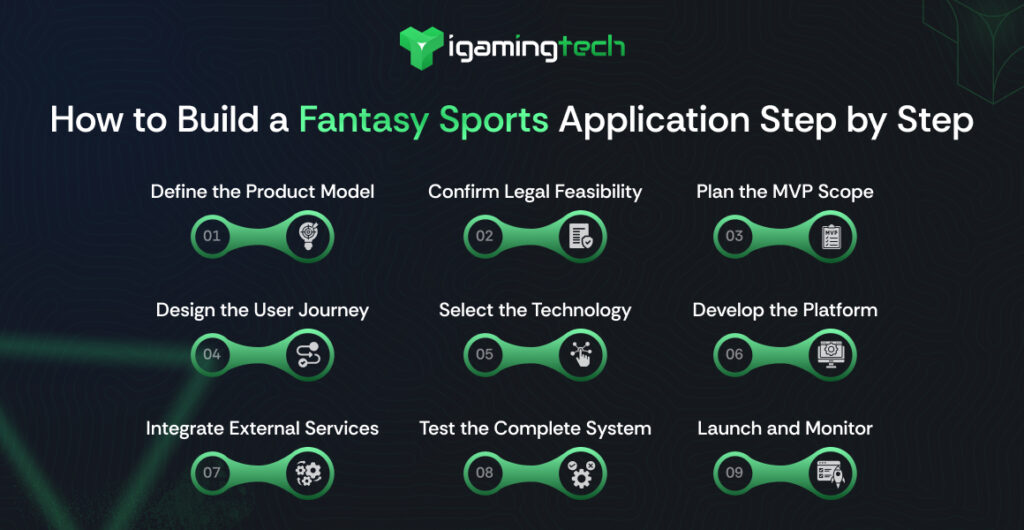
How to Build a Fantasy Sports App Step by Step
Building a reliable platform requires clear product decisions before development begins. The process should connect contest rules with technology, compliance, and daily operations. These steps explain how to build a fantasy sports app without adding unnecessary complexity.
1. Define the Product Model
Select the first sport, target audience, and contest format. Decide whether the platform will offer free contests or paid competitions. These choices shape every later requirement.
2. Confirm Legal Feasibility
Review the rules for each target market before planning the complete product. Legal guidance can identify age limits, location controls, and licensing needs.
3. Plan the MVP Scope
An MVP includes the essential features needed for the first release. Prioritize registration, team creation, scoring, payments, and admin controls.
4. Design the User Journey
Map every action before creating the interface. The journey should cover registration, contest discovery, team selection, entry submission, and prize withdrawal.
5. Select the Technology
Choose technologies based on traffic needs, real-time data speed, and security. The stack should also support future sports and contest formats.
6. Develop the Platform
Build user accounts and contest logic, the scoring engine, and wallet functions. A structured iGaming platform development approach can also connect admin controls with payment and verification systems.
7. Integrate External Services
Connect sports data, payment gateways, identity verification, and geolocation tools. Each integration should include failure alerts and clear recovery rules.
8. Test the Complete System
Test scoring accuracy, contest locks, payments and withdrawals, and traffic performance. Security testing should also check account access and data protection.
9. Launch and Monitor
Release the product after technical and legal approval. Teams should monitor data feeds and transactions, contest performance, and user issues after launch.
The fantasy sports app development process should remain flexible. Early user behavior can reveal which features need improvement before the platform expands.
How Much Does It Cost to Build a Fantasy Sports App Like FanDuel?
The fantasy sports app development cost may start near $35,000 for a focused Minimum Viable Product. A more advanced platform may cost $80,000 to $200,000 or more. These figures are market estimates. The final budget depends on product scope and data needs and launch regions.
| Product Level | Estimated Cost | Typical Scope |
| MVP platform | $35,000 to $80,000 | One sport, basic contests, live scoring, wallet, and admin controls. |
| Advanced platform | $80,000 to $200,000 or more | Multiple sports, custom contests, strong compliance, and high traffic support. |
| FanDuel scale platform | Custom estimate | Large user volumes, complex operations, multiple products, and ongoing expansion. |
The FanDuel app development cost cannot be reduced to one fixed figure. FanDuel operates at a scale that includes mature systems and large operational teams. A startup should estimate the first launch instead of pricing the complete FanDuel ecosystem.
1. Product Scope
Each new sport adds scoring rules, player data, and contest logic. Multiple contest formats also increase design and testing work. A focused first release can control the early budget.
2. Platform Coverage
One mobile platform costs less than separate iOS and Android applications. A web platform adds another interface and more testing. Cross-platform development may reduce duplicate work.
3. Live Sports Data
Licensed sports data can create recurring fees. Faster feeds and wider league coverage may increase the price. Statistical correction access can also affect provider costs.
4. Payments and Compliance
Paid contests need payment gateways, identity checks, and geolocation controls. Strong fraud monitoring and audit records add more development work. Legal review may create separate expenses.
5. Performance Requirements
Major events can create sudden traffic spikes. High user capacity needs stronger cloud architecture, load testing, and monitoring. These requirements increase the initial fantasy sports app development cost.
6. Ongoing Operating Costs
The budget should continue after launch. Common expenses include sports data, cloud hosting, payment processing, and verification tools. Maintenance, security reviews, and customer support also need regular funding. The iGamingTech guide on sports betting app development cost explains similar long-term cost categories for real money sports platforms.
A reliable estimate should follow product discovery. The development team must define the sport and platform and contest model and target region before quoting the project.
Common Development Risks and Testing Needs
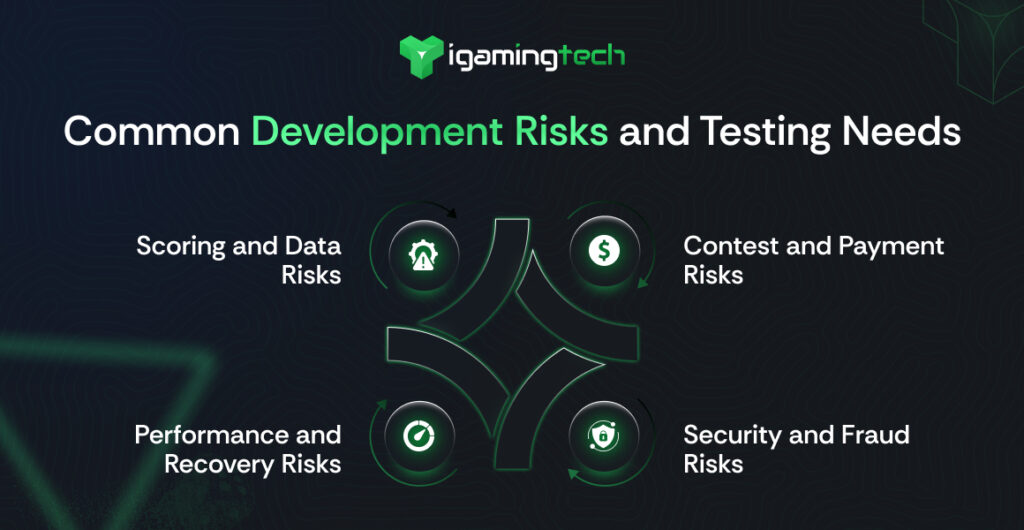
Fantasy sports software development involves live data, financial activity, and time sensitive contests. A small failure can affect rankings, payments, or user trust. Teams should test each critical workflow before launch.
1. Scoring and Data Risks
Incorrect data can change contest results.
Scoring tests: Teams should verify every scoring rule with sample match data.
Correction tests: The system should recalculate points after official data changes.
Feed failure tests: The platform should respond safely when live data stops.
2. Contest and Payment Risks
Contest locks and payments must work at the correct time.
Lock testing: The platform should block entries after the deadline.
Payment testing: Teams should test deposits, refunds, and withdrawals.
Settlement testing: The system should release the correct prize after final approval.
3. Security and Fraud Risks
Paid contests can attract account misuse.
Account testing: Teams should check login protection and identity controls.
Fraud testing: The platform should detect duplicate accounts and suspicious withdrawals.
Location testing: The system should block access in restricted regions.
4. Performance and Recovery Risks
Major events can create sudden traffic growth.
Load testing: Teams should simulate heavy activity before contest locks.
Recovery testing: The platform should restore services without losing transaction records.
Monitoring tests: Alerts should detect failed services and slow responses.
How Fantasy Sports Apps Generate Revenue
A fantasy sports platform needs a clear revenue model before launch. The selected model should match the contest format and target market. Operators should also confirm that each revenue source follows local rules.
1. Contest Entry Commission
The platform can retain a fixed percentage from paid contest entry pools. The remaining amount becomes the prize pool.
2. Subscription Plans
Users can pay for premium research tools and deeper player insights. Subscriptions can create predictable recurring revenue.
3. Sponsored Contests
Sports brands can sponsor selected contests or seasonal campaigns. Clear disclosure should identify every paid partnership.
4. Advertising Revenue
The platform can display relevant advertisements across free contest areas. Ads should not interrupt team selection or live scoring.
5. Premium Analytics
Users can pay for advanced statistics and lineup insights. Custom fantasy sports app development can connect these tools with reliable sports data.
6. Partnership Revenue
Operators can work with leagues, sports media companies, and payment providers. Each partnership should add clear value for users.
Launch Your Fantasy Sports App With the Right Technology —Start Your Project Today!
Contact Us
How to Choose a Fantasy Sports App Development Company
A capable partner should understand live contest systems and financial workflows. Mobile design skills alone are not enough. Operators should assess technical knowledge and delivery terms before signing an agreement.
1. Relevant Platform Experience
Real-time systems: The team should know live sports data and scoring workflows.
Fantasy logic: Developers should understand contests, player drafts, and settlements.
2. Security and Compliance Knowledge
Payment protection: The team should secure deposits and withdrawals and transaction records.
Regional controls: Developers should understand identity checks and geolocation requirements.
3. Ownership and Delivery Terms
Source code rights: The agreement should define ownership before development begins.
Clear roadmap: The team should provide phases and timelines and cost details.
4. Support and Scalability
Post-launch support: The partner should manage fixes and updates after release.
Scalable architecture: The platform should handle new sports and growing traffic.
Operators should compare architecture, ownership, and support terms before selecting a fantasy sports app development company. iGamingTech offers dedicated development resources for custom gaming platforms. Its hire sports betting software developers page can support readers who need a specialized technical team.
Final Thoughts
A successful platform starts with a clear contest model and reliable sports data. It also needs accurate scoring, secure payments, and strong compliance controls. Operators should define the first launch scope before estimating the budget. This approach keeps fantasy sports app development focused and reduces unnecessary complexity. iGamingTech can help businesses plan and build custom platforms around real product goals. A focused strategy can create a stronger foundation for future sports and markets.
Ready To Build Your Own Sportsbook Platform?
Launch a secure, scalable, and fully integrated sportsbook designed to grow your business faster.


